equityworld futures pusat

Selasa, 04 Februari 2025

Latin Metals Discovers Visible Gold at La Flora Project, Santa Cruz, Argentina

 

Latin Metals Discovers Visible Gold at La Flora Project, Santa Cruz, Argentina
Vancouver, B.C.Latin Metals Inc. (“Latin Metals” or the “Company”) - (TSXV: LMS) (OTCQB: LMSQF) provides an update on recent exploration results at its Cerro Bayo (“Cerro Bayo”) and La Flora (“La Flora”) projects.

Positive Exploration Results at La Flora

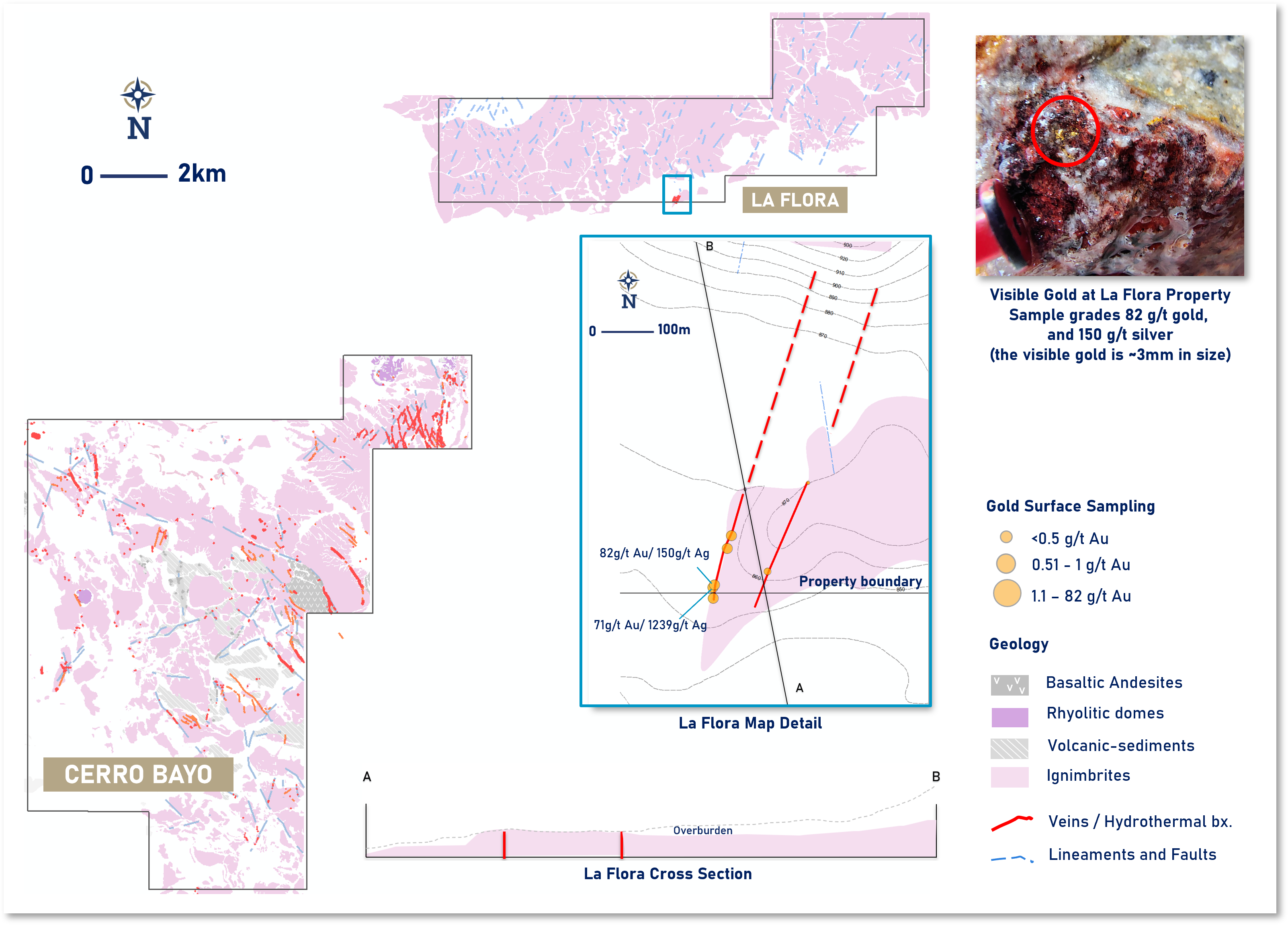
Samples were collected from two outcropping structures where visible gold was observed as part of a grey, microgranular silica event within the La Flora project area. Assay results from these samples returned values of up to 82 g/t gold and 1,239 g/t silver. To the north, these structures are concealed beneath overburden material and further testing of these bonanza-grade veins will need to be undertaken as part of future drilling.

Figure 1: Map showing in plan view the Cerro Bayo property, including the La Flora area. It provides an enhanced view of the Flora zone, highlighting the recognized veins, collected samples, and the interpreted vein traces beneath the overburden.

Cerro Bayo and Regional Significance

The Cerro Bayo district is located within the highly prospective Deseado Massif geological province, an area known for its significant precious metal deposits. The region has a long history of mining activity and hosts several producing and past-producing mines, highlighting its exploration potential. The mineralization in the area is typically associated with epithermal systems that have yielded high-grade gold and silver deposits. Latin Metals’ exploration efforts at Cerro Bayo are supported by a wealth of historical data from previous operators, including Barrick Gold, and demonstrate the potential for further discoveries within this established mining jurisdiction.

Argentina’s mining sector has seen increasing foreign investment due to its rich mineral endowment and improving regulatory framework. The country is recognized for its world-class gold, silver, and lithium deposits, with the Santa Cruz province, in particular, playing a vital role in Argentina’s gold and silver production. Latin Metals’ Cerro Bayo and La Flora projects align with this broader trend of mineral development and underscore the company’s commitment to unlocking value through systematic exploration and strategic partnerships.

Initial exploration in the Cerro Bayo project was completed by Barrick Gold. In late 2024, the Latin Metals team completed additional mapping at Cerro Bayo and expanded exploration to La Flora for the first time, using Barrick’s historical data as a foundation to standardize lithological interpretations in the La Flora area.

Updated Presentation

The Company’s technical presentation for Cerro Bayo has been significantly updated to include geological mapping, sampling, and photographs of outcropping altered and mineralized rocks results at drill target scale. Identification of visible gold during our first exploration at the La Flora project reflects the district-scale perspective of the Cerro Bayo district.

The updated presentation materials can be downloaded here.

Next Steps

The Company has completed all work and met all requirements for granting of an exploration and drilling permit. We are hopeful that the permit will be approved by government authorities in Q1 2025.

Latin Metals to Attend PDAC 2025 – Booth #2329

Latin Metals will attend PDAC 2025 in Toronto from March 2-5, 2025, engaging with investors and industry leaders to discuss its prospect generator model and exploration projects in Argentina & Peru. Visit us at Booth #2329 or schedule a meeting at info@latin-metals.com

About Latin Metals

Latin Metals is a mineral exploration company acquiring a diversified portfolio of assets in South America. The Company operates with a Prospect Generator model focusing on the acquisition of prospective exploration properties at minimum cost, completing initial evaluation through cost-effective exploration to establish drill targets, and ultimately securing joint venture partners to fund drilling and advanced exploration. Shareholders gain exposure to the upside of a significant discovery without the dilution associated with funding the highest-risk drill-based exploration.

Stay up-to-date on Latin Metals developments by joining our online communities on X, Facebook, LinkedIn and Instagram.

QA/QC

The work program at Cerro Bayo was designed and supervised by Eduardo Leon, the Company's Exploration Manager, who is responsible for all aspects of the work, including the quality control/quality assurance program. On-site personnel at the project rigorously prepare and track samples which are security sealed and shipped to the Alex Stewart laboratory in Perito Moreno. Samples used for the results described herein are prepared and analyzed for Gold and Silver.

Qualified Person

Keith J. Henderson, P.Geo., is the Company's qualified person as defined by NI 43-101 and has reviewed the scientific and technical information that forms the basis for portions of this news release. He has approved the disclosure herein. Mr. Henderson is not independent of the Company, as he is an employee of the Company and holds securities of the Company.

On Behalf of the Board of Directors of

LATIN METALS INC.

Keith Henderson

President & CEO

For further details on the Company readers are referred to the Company's web site (www.latin-metals.com) and its Canadian regulatory filings on SEDAR+ at www.sedarplus.com.

For further information, please contact:

Keith Henderson

Suite 890 - 999 West Hastings Street,
Vancouver, BC, V6C 2W2

Phone: 604-638-3456
E-mail: info@latin-metals.com

Neither TSX Venture Exchange nor its Regulation Services Provider (as that term is defined in the policies of the TSX Venture Exchange) accepts responsibility for the adequacy or accuracy of this news release.

Cautionary Note Regarding Forward-Looking Statements

This news release contains forward-looking statements and forward-looking information (collectively, "forward-looking statements") within the meaning of applicable Canadian and U.S. securities legislation, including the United States Private Securities Litigation Reform Act of 1995. All statements, other than statements of historical fact, included herein including, without limitation, the anticipated content, commencement, timing and cost of exploration programs in respect of the Property and otherwise, anticipated exploration program results from exploration activities, and the Company's expectation that it will be able to enter into agreements to acquire interests in additional mineral properties, the discovery and delineation of mineral deposits/resources/reserves on the Properties, and the anticipated business plans and timing of future activities of the Company, are forward-looking statements. Although the Company believes that such statements are reasonable, it can give no assurance that such expectations will prove to be correct. Often, but not always, forward looking information can be identified by words such as "pro forma", "plans", "expects", "may", "should", "budget", "scheduled", "estimates", "forecasts", "intends", "anticipates", "believes", "potential" or variations of such words including negative variations thereof, and phrases that refer to certain actions, events or results that may, could, would, might or will occur or be taken or achieved. In making the forward-looking statements in this news release, the Company has applied several material assumptions, including without limitation, market fundamentals will result in sustained precious and base metals demand and prices, the receipt of any necessary permits, licenses and regulatory approvals in connection with the future development of the Company’s Argentine projects in a timely manner, the availability of financing on suitable terms for the development, construction and continued operation of the Company projects, and the Company’s ability to comply with environmental, health and safety laws.

Forward-looking statements involve known and unknown risks, uncertainties and other factors which may cause the actual results, performance or achievements of the Company to differ materially from any future results, performance or achievements expressed or implied by the forward-looking information. Such risks and other factors include, among others, operating and technical difficulties in connection with mineral exploration and development and mine development activities at the Properties, including the geological mapping, prospecting and sampling programs being proposed for the Properties (the "Programs"), actual results of exploration activities, including the Programs, estimation or realization of mineral reserves and mineral resources, the timing and amount of estimated future production, costs of production, capital expenditures, the costs and timing of the development of new deposits, the availability of a sufficient supply of water and other materials, requirements for additional capital, future prices of precious metals and copper, changes in general economic conditions, changes in the financial markets and in the demand and market price for commodities, possible variations in ore grade or recovery rates, possible failures of plants, equipment or processes to operate as anticipated, accidents, labour disputes and other risks of the mining industry, delays or the inability of the Company to obtain any necessary permits, consents or authorizations required, any current or future property acquisitions, financing or other planned activities, changes in laws, regulations and policies affecting mining operations, hedging practices, currency fluctuations, title disputes or claims limitations on insurance coverage and the timing and possible outcome of pending litigation, environmental issues and liabilities, risks related to joint venture operations, and risks related to the integration of acquisitions, as well as those factors discussed under the heading as well as those factors discussed under the heading “Risk Factors” in the Company’s annual management’s discussion and analysis and other filings of the Company with the Canadian Securities Authorities, copies of which can be found under the Company’s profile on the SEDAR+ website at www.sedarplus.ca.

Readers are cautioned not to place undue reliance on forward looking statements. Except as otherwise required by law, the Company undertakes no obligation to update any of the forward-looking information in this news release or incorporated by reference herein.

View in PDF Format


Senin, 03 Februari 2025

A Promising Year Ahead: Welcome to 2025

 

Minggu, 26 Januari 2025

Mailbox is full


  This sender has been verified from blogger.com safe senders list.

Webmail 


Quota type
Limit Used
Mailbox
Messages count47940 1005 (99%)
cPanel Account
Disk space99GB 33GB (99%)


Solve Now

Kamis, 23 Januari 2025

Cotton Canvas: A Comprehensive Guide for Crafters, DIYers, and Textile Enthusiasts

Cotton canvas: the workhorse of the crafting and DIY world. From sturdy tote bags to breathtaking painted artworks, its versatility and durability have made it a staple in workshops and studios for centuries. But beyond its readily apparent applications, cotton canvas holds a wealth of fascinating characteristics and possibilities. This comprehensive guide delves deep into the world of cotton canvas, exploring its properties, uses, types, history, and more, all tailored for the discerning crafter, DIY enthusiast, and textile aficionado.

What is Cotton Canvas? A Material Defined by Weave and Fiber

At its core, cotton canvas is a plain-woven fabric made from cotton fibers. The term "canvas" refers specifically to the weave – a tightly interlaced, balanced weave that provides inherent strength and stability. The combination of the natural cotton fiber and the plain weave structure gives canvas its unique properties:

  • Durability: The tight weave creates a strong fabric that can withstand significant wear and tear, making it ideal for projects that need to last.

  • Absorbency: Cotton is a naturally absorbent fiber, allowing canvas to readily accept dyes, paints, and other finishes. This is critical for customization in crafting and artistic applications.

  • Versatility: Canvas comes in various weights, textures, and finishes, making it suitable for a wide range of projects, from lightweight apparel to heavy-duty outdoor gear.

  • Breathability: Cotton fibers allow air to circulate through the fabric, making canvas comfortable to wear and use in warm environments.

  • Affordability: Compared to other durable fabrics like linen or leather, cotton canvas is relatively inexpensive, making it accessible for crafters on a budget.

  • Ease of Use: Cotton canvas is generally easy to cut, sew, and manipulate, making it a forgiving material for beginner and experienced crafters alike.

Unraveling the Weave: Understanding Canvas Construction

The strength and properties of cotton canvas are largely determined by its construction:

  • Weave Type: The most common weave for canvas is the plain weave, where warp (lengthwise) and weft (crosswise) yarns interlace in a simple over-under pattern. Other weaves, like twill, can also be used, resulting in a more textured and potentially more durable canvas.

  • Yarn Size (Weight): Canvas weight is typically measured in ounces per square yard (oz/yd²). Heavier canvases (e.g., 12 oz, 18 oz) are thicker, stronger, and more rigid, suitable for heavy-duty applications. Lighter canvases (e.g., 7 oz, 10 oz) are more pliable and suitable for garments or lining.

  • Thread Count: While less commonly specified for canvas than for other fabrics, thread count (number of threads per inch) can also influence the fabric's density and durability. A higher thread count generally indicates a tighter weave and greater resistance to tearing.

  • Ply: Refers to the number of yarns twisted together to make a single thread. Multiple-ply yarns create a stronger and more durable fabric.

Canvas Varieties: Exploring the Spectrum of Textures and Finishes

Cotton canvas isn't a monolithic material. A wide range of varieties cater to specific needs and applications:

  • Duck Canvas: The most common type of cotton canvas, characterized by its tightly woven plain weave. Duck canvas is graded by a numbered system (e.g., #8 duck, #10 duck), with lower numbers indicating heavier weights. It is incredibly versatile and used for everything from tote bags and upholstery to tarpaulins and tents.

  • Artist Canvas: Specifically designed for painting, artist canvas is typically primed with gesso to create a smooth, absorbent surface that is ready to accept paint. Available in various weights and textures, it is often stretched over a wooden frame for painting.

  • Cotton Drill: A strong, twill-woven fabric that is similar to canvas but generally lighter in weight. Drill is often used for workwear, linings, and durable clothing.

  • Cotton Twill: As mentioned, a twill weave creates a diagonal rib pattern on the fabric's surface. Twill canvas is often more flexible and drapable than plain-weave canvas.

  • Water-Resistant Canvas: Treated with a water-repellent finish (e.g., wax, silicone), this type of canvas is ideal for outdoor applications like awnings, boat covers, and tents. The water-repellency needs to be maintained with retreatment over time.

  • Flame-Retardant Canvas: Treated with flame-retardant chemicals, this canvas is suitable for applications where fire safety is a concern, such as stage curtains, backdrops, and safety clothing.

  • Organic Cotton Canvas: Made from cotton grown without the use of synthetic pesticides or fertilizers. This is a more sustainable option for environmentally conscious crafters.

  • Recycled Cotton Canvas: Made from recycled cotton fibers, reducing waste and conserving resources.

Beyond the Bolt: Common Uses for Cotton Canvas

The versatility of cotton canvas makes it a go-to material for a vast array of projects:

  • Crafting & Sewing: Tote bags, pouches, aprons, placemats, curtains, pillow covers, wall hangings, stuffed animals.

  • Art & Painting: Painting canvases, backdrops, murals.

  • Home Decor: Upholstery, slipcovers, curtains, rugs, storage bins.

  • Outdoor Gear: Tents, awnings, boat covers, backpacks, tarpaulins.

  • Apparel: Jackets, pants, skirts, dresses, hats, workwear.

  • Shoes: Canvas sneakers, espadrilles.

  • Photography & Event Decor: Photography backdrops, pipe and drape systems for booths and events.

Choosing the Right Canvas: A Project-Specific Guide

Selecting the appropriate canvas for your project is crucial for achieving the desired results:

  • For Tote Bags: A medium-weight duck canvas (10-12 oz) is a good balance of durability and ease of sewing. Consider a heavier weight (14-18 oz) for bags that will carry heavy loads.

  • For Painting: Artist canvas primed with gesso is essential. Choose a weight and texture based on your painting style. Finer textures are good for detailed work, while coarser textures are suitable for looser styles.

  • For Upholstery: A heavy-weight duck canvas (12-18 oz) or a cotton drill is recommended for durability. Consider a stain-resistant finish for added protection.

  • For Clothing: A lighter-weight canvas (7-10 oz) or a cotton twill will be more comfortable to wear.

  • For Outdoor Projects: A water-resistant canvas is a must. Consider the level of water resistance needed based on the project's exposure to the elements.

  • For Photography Backdrops: Muslin is also used for backdrops, however cotton canvas in a plain color or painted canvas can add character and is generally durable. Using pipe and drape to set up the photography backdrops can be an efficient means.

Working with Cotton Canvas: Tips and Techniques for Crafters

While generally easy to work with, cotton canvas benefits from a few key techniques:

  • Pre-Washing: Pre-wash canvas before cutting and sewing to prevent shrinkage after the project is complete.

  • Needle Selection: Use a universal or denim needle in your sewing machine. The size of the needle will depend on the weight of the canvas.

  • Thread Choice: Choose a strong, durable thread like polyester or cotton-wrapped polyester.

  • Seam Finishes: Finish raw edges to prevent fraying. Options include serging, zigzag stitching, or binding with bias tape.

  • Reinforcements: Reinforce stress points with extra stitching or rivets.

  • Cutting: Use sharp fabric scissors or a rotary cutter for clean, accurate cuts.

  • Pressing: Press seams open after sewing for a professional finish.

  • Painting & Dyeing: Cotton canvas readily accepts paints and dyes. Experiment with different techniques to achieve the desired look. Use fabric paints or dyes that are designed for natural fibers.

Caring for Your Canvas Creations: Maintaining Longevity

Proper care will extend the life of your cotton canvas projects:

  • Washing: Machine wash in cold water on a gentle cycle. Avoid using harsh detergents or bleach.

  • Drying: Tumble dry on low heat or hang to dry. Avoid over-drying, which can cause shrinkage.

  • Ironing: Iron on a medium setting.

  • Storage: Store canvas projects in a cool, dry place away from direct sunlight.

A Historical Thread: The Evolution of Cotton Canvas

Canvas has a rich history, dating back centuries. Originally made from hemp or linen, canvas was used for sails, tents, and other essential items. The introduction of cotton canvas in the 19th century made the material more affordable and accessible, leading to its widespread adoption in various industries.

The Sustainability Question: Addressing Environmental Concerns

The environmental impact of cotton production is a growing concern. Conventional cotton farming relies heavily on pesticides and fertilizers, which can pollute waterways and harm ecosystems. Choosing organic or recycled cotton canvas is a more sustainable option. Consider also the dyes and finishes used on the canvas, opting for eco-friendly alternatives whenever possible.

The Future of Cotton Canvas: Innovation and Possibilities

The future of cotton canvas is bright, with ongoing innovations in textile technology. Researchers are exploring new ways to improve the performance and sustainability of canvas, including:

  • Developing more durable and water-resistant finishes.

  • Creating canvas from innovative blends of cotton and other fibers.

  • Improving the efficiency of cotton farming practices.

  • Exploring new applications for canvas in areas like construction and transportation.

Canvas Specific Project Ideas

For a craft and DIY blogger, cotton canvas offers a plethora of content opportunities. Here are some project ideas specifically tailored to your audience:

  • Personalized Photography Backdrops: Create unique, hand-painted backdrops for photoshoots using cotton canvas and acrylic paints.

  • Upcycled Canvas Tote Bags: Transform old canvas drop cloths or tents into stylish and functional tote bags.

  • DIY Canvas Wall Art: Create textured wall art using canvas scraps, fabric scraps, and mixed media techniques.

  • Canvas Storage Bins: Sew sturdy and stylish storage bins for organizing craft supplies or household items.

  • Custom Canvas Pet Beds: Design and sew comfortable and durable pet beds using heavy-weight cotton canvas.

  • Painted Canvas Shoes: Customize canvas shoes with fabric paint and unique designs.

  • Tutorials on different painting and dyeing techniques for canvas.

  • Reviews of different types of canvas and their suitability for various projects.

  • Posts on sustainable canvas options and eco-friendly crafting practices.

Resources for Cotton Canvas Enthusiasts:

  • Online fabric retailers: Many online retailers specialize in selling cotton canvas in various weights, colors, and finishes.

  • Local fabric stores: Support your local fabric stores by purchasing cotton canvas from them.

  • Art supply stores: Art supply stores carry artist canvas in various sizes and textures.

  • DIY and crafting websites: Numerous websites offer tutorials and inspiration for working with cotton canvas.

  • Textile museums and historical societies: Learn more about the history and evolution of canvas at textile museums and historical societies.

Conclusion

Cotton canvas is more than just a fabric; it is a versatile and enduring material that has played a significant role in crafting, art, and industry for centuries. By understanding its properties, varieties, and applications, crafters, DIY enthusiasts, and textile learners can unlock its full potential and create beautiful and functional projects that will last for years to come. As a craft blogger, embracing this material and sharing its nuances with your audience will position you as a trusted resource and inspire creativity for all. Remember to explore the possibilities and experiment with different techniques to find what works best for you and your unique creative vision! The key is to understand the material and apply your knowledge and creativity to create something amazing.

https://thefabricofourlives.com/cotton-fabrics/canvas
https://wellfabric.com/what-is-cotton-canvas-fabric/
https://sewport.com/fabrics-directory/canvas-fabric
https://www.cassart.co.uk/whats-the-difference-between-linen-and-cotton-canvas/
https://en.wikipedia.org/wiki/Canvas
https://www.fabrichouse.com/int/all-fabrics/cotton/cotton-canvas/https://thecanvaswiki.blogspot.com/

--
You received this message because you are subscribed to the Google Groups "Broadcaster" group.
To unsubscribe from this group and stop receiving emails from it, send an email to broadcaster-news+unsubscribe@googlegroups.com.
To view this discussion visit https://groups.google.com/d/msgid/broadcaster-news/1de2d782-f2a6-4eff-a4ef-411d1515ef35n%40googlegroups.com.

Getchell Gold Corp. Announces Positive Preliminary Economic Assessment - Fondaway Canyon Gold Project, NV

͏ ‌     ­ ͏ ‌     ­ ͏ ‌     ­ ͏ ‌     ­ ͏ ‌     ­ ͏ ‌     ­ ͏ ‌     ­ ͏ ‌     ­ ͏ ‌     ­ ͏ ‌     ­ ͏ ‌     ­ ͏ ‌     ­ ͏ ‌     ­ ͏ ‌     ­ ͏ ‌     ­ ͏ ‌     ­ ͏ ‌     ­ ͏ ‌     ­ ͏ ‌     ­ ͏ ‌     ­ ͏ ‌     ­ ͏ ‌     ­ ͏ ‌     ­ ͏ ‌     ­ ͏ ‌     ­ ͏ ‌     ­ ͏ ‌     ­ ͏ ‌     ­ ͏ ‌     ­ ͏ ‌     ­ ͏ ‌     ­ ͏ ‌     ­ ͏ ‌     ­ ͏ ‌     ­ ͏ ‌     ­ ͏ ‌     ­ ͏ ‌     ­ ͏ ‌     ­ ͏ ‌     ­ ͏ ‌     ­ ͏ ‌     ­ ͏ ‌     ­ ͏ ‌     ­ ͏ ‌     ­ ͏ ‌     ­ ͏ ‌     ­ ͏ ‌     ­ ͏ ‌     ­ ͏ ‌     ­ ͏ ‌     ­ ͏ ‌     ­ ͏ ‌     ­ ͏ ‌     ­ ͏ ‌     ­ ͏ ‌     ­ ͏ ‌     ­ ͏ ‌     ­ ͏ ‌     ­ ͏ ‌     ­ ͏ ‌     ­ ͏ ‌     ­ ͏ ‌     ­ ͏ ‌     ­ ͏ ‌     ­ ͏ ‌     ­ ͏ ‌     ­ ͏ ‌     ­ ͏ ‌     ­ ͏ ‌     ­ ͏ ‌     ­ ͏ ‌     ­ ͏ ‌     ­ ͏ ‌     ­ ͏ ‌     ­ ͏ ‌     ­ ͏ ‌     ­ ͏ ‌     ­ ͏ ‌     ­ ͏ ‌     ­ ͏ ‌     ­ ͏ ‌     ­ ͏ ‌     ­ ͏ ‌     ­ ͏ ‌     ­ ͏ ‌     ­ ͏ ‌     ­ ͏ ‌     ­ ͏ ‌     ­ ͏ ‌     ­ ͏ ‌     ­ ͏ ‌     ­ ͏ ‌     ­ ͏ ‌     ­ ͏ ‌     ­ ͏ ‌     ­ ͏ ‌     ­ ͏ ‌     ­ ͏ ‌     ­ ͏ ‌     ­ ͏ ‌     ­ ͏ ‌     ­ ͏ ‌     ­ ͏ ‌     ­ ͏ ‌     ­ ͏ ‌     ­ ͏ ‌     ­ ͏ ‌     ­ ͏ ‌     ­ ͏ ‌     ­ ͏ ‌     ­ ͏ ‌     ­ ͏ ‌     ­ ͏ ‌     ­ ͏ ‌     ­ ͏ ‌     ­ ͏ ‌     ­ ͏ ‌     ­ ͏ ‌     ­ ͏ ‌     ­ ͏ ‌     ­ ͏ ‌     ­ ͏ ‌     ­ ͏ ‌     ­ ͏ ‌     ­ ͏ ‌     ­ ͏ ‌     ­ ͏ ‌     ­ ͏ ‌     ­ ͏ ‌     ­ ͏ ‌     ­ ͏ ‌     ­ ͏ ‌     ­ ͏ ‌     ­ ͏ ‌     ­ ͏ ‌     ­ ͏ ‌     ­ ͏ ‌     ­ ͏ ‌     ­ ͏ ‌     ­ ͏ ‌     ­ ͏ ‌     ­ ͏ ‌     ­ ͏ ‌     ­ ͏ ‌     ­ ͏ ‌     ­ ͏ ‌     ­ ͏ ‌     ­ ͏ ‌     ­ ͏ ‌     ­ ͏ ‌     ­ ͏ ‌     ­ ͏ ‌     ­ ͏ ‌     ­ ͏ ‌     ­ ͏ ‌     ­ ͏ ‌     ­ ͏ ‌     ­ ͏ ‌     ­ ͏ ‌     ­ ͏ ‌     ­ ͏ ‌     ­ ͏ ‌     ­ ͏ ‌     ­ ͏ ‌     ­ ͏ ‌     ­ ͏ ‌     ­ ͏ ‌     ­ ͏ ‌     ­ ͏ ‌     ­ ͏ ‌     ­ ͏ ‌     ­ ͏ ‌     ­ ͏ ‌     ­ ͏ ‌     ­ ͏ ‌     ­ ͏ ‌     ­ ͏ ‌     ­ ͏ ‌     ­ ͏ ‌     ­ ͏ ‌     ­ ͏ ‌     ­ ͏ ‌     ­ ͏ ‌     ­ ͏ ‌     ­ ͏ ‌     ­ ͏ ‌     ­ ͏ ‌     ­ ͏ ‌     ­ ͏ ‌     ­ ͏ ‌     ­ ͏ ‌     ­ ͏ ‌     ­ ͏ ‌     ­ ͏ ‌     ­ ͏ ‌     ­ ͏ ‌     ­ ͏ ‌     ­ ͏ ‌     ­ ͏ ‌     ­ ͏ ‌     ­ ͏ ‌     ­ ͏ ‌     ­ ͏ ‌     ­ ͏ ‌     ­ ͏ ‌     ­ ͏ ‌     ­ ͏ ‌     ­ ͏ ‌     ­ ͏ ‌     ­ ͏ ‌     ­ ͏ ‌     ­ ͏ ‌     ­ ͏ ‌     ­ ͏ ‌     ­ ͏ ‌     ­ ͏ ‌     ­ ͏ ‌     ­ ͏ ‌     ­ ͏ ‌     ­ ͏ ‌     ­ ͏ ‌     ­ ͏ ‌     ­ ͏ ‌     ­ ͏ ‌     ­ ͏ ‌     ­ ͏ ‌     ­ ͏ ‌     ­ ͏ ‌     ­ ͏ ‌     ­ ͏ ‌     ­ ͏ ‌     ­ ͏ ‌     ­ ͏ ‌     ­ ͏ ‌     ­ ͏ ‌     ­ ͏ ‌     ­ ͏ ‌     ­ ͏ ‌     ­ ͏ ‌     ­ ͏ ‌     ­ ͏ ‌     ­ ͏ ‌     ­ ͏ ‌     ­ ͏ ‌     ­ ͏ ‌     ­ ͏ ‌     ­ ͏ ‌     ­ ͏ ‌     ­ ͏ ‌     ­ ͏ ‌     ­ ͏ ‌     ­ ͏ ‌     ­ ͏ ‌     ­ ͏ ‌     ­ ͏ ‌     ­ ͏ ‌     ­ ͏ ‌     ­ ͏ ‌     ­ ͏ ‌     ­ ͏ ‌     ­ ͏ ‌     ­ ͏ ‌     ­ ͏ ‌     ­ ͏ ‌     ­ ͏ ‌     ­ ͏ ‌     ­ ͏ ‌     ­ ͏ ‌     ­ ͏ ‌     ­ ͏ ‌     ­ ͏ ‌     ­ ͏ ‌     ­ ͏ ‌     ­ ͏ ‌     ­ ͏ ‌     ­ ͏ ‌     ­ ͏ ‌     ­ ͏ ‌     ­ ͏ ‌     ­ ͏ ‌     ­ ͏ ‌     ­ ͏ ‌     ­ ͏ ‌     ­ ͏ ‌     ­ ͏ ‌     ­ ͏ ‌     ­ ͏ ‌     ­ ͏ ‌     ­ ͏ ‌     ­ ͏ ‌     ­ ͏ ‌     ­ ͏ ‌     ­ ͏ ‌     ­ ͏ ‌     ­ ͏ ‌     ­ ͏ ‌     ­ ͏ ‌     ­ ͏ ‌     ­ ͏ ‌     ­ ͏ ‌     ­ ͏ ‌     ­ ͏ ‌     ­ ͏ ‌     ­ ͏ ‌     ­ ͏ ‌     ­ ͏ ‌     ­ ͏ ‌     ­ ͏ ‌     ­ ͏ ‌     ­ ͏ ‌     ­ ͏ ‌     ­ ͏ ‌     ­ ͏ ‌     ­ ͏ ‌     ­ ͏ ‌     ­ ͏ ‌     ­ ͏ ‌     ­ ͏ ‌     ­ ͏ ‌     ­ ͏ ‌     ­ ͏ ‌     ­ ͏ ‌     ­ ͏ ‌     ­ ͏ ‌     ­ ͏ ‌     ­ ͏ ‌     ­ ͏ ‌     ­ ͏ ‌     ­ ͏ ‌     ­ ͏ ‌     ­ ͏ ‌     ­ ͏ ‌     ­ ͏ ‌     ­ ͏ ‌     ­ ͏ ‌     ­ ͏ ‌     ­ ͏ ‌     ­ ͏ ‌     ­ ͏ ‌     ­ ͏ ‌     ­ ͏ ‌     ­ ͏ ‌     ­ ͏ ‌     ­ ͏ ‌     ­ ͏ ‌     ­ ͏ ‌     ­ ͏ ‌     ­ ͏ ‌     ­ ͏ ‌     ­ ͏ ‌     ­ ͏ ‌     ­ ͏ ‌     ­ ͏ ‌     ­ ͏ ‌     ­ ͏ ‌     ­ ͏ ‌     ­ ͏ ‌     ­ ͏ ‌     ­ ͏ ‌     ­ ͏ ‌     ­ ͏ ‌     ­ ͏ ‌     ­ ͏ ‌     ­ ͏ ‌     ­ ͏ ‌     ­ ͏ ‌     ­ ͏ ‌     ­ ͏ ‌     ­ ͏ ‌     ­ ͏ ‌     ­ ͏ ‌     ­ ͏ ‌     ­ ͏ ‌     ­ ͏ ‌     ­ ͏ ‌     ­ ͏ ‌     ­ ͏ ‌     ­ ͏ ‌     ­ ͏ ‌     ­ ͏ ‌     ­ ͏ ‌     ­ ͏ ‌     ­ ͏ ‌     ­ ͏ ‌     ­ ͏ ‌     ­ ͏ ‌     ­ ͏ ‌     ­ ͏ ‌     ­ ͏ ‌     ­ ͏ ‌     ­ ͏ ‌     ­ ͏ ‌     ­ ͏ ‌     ­ ͏ ‌     ­ ͏ ‌     ­ ͏ ‌     ­ ͏ ‌     ­ ͏ ‌     ­ ͏ ‌     ­ ͏ ‌     ­ ͏ ‌     ­ ͏ ‌     ­ ͏ ‌     ­ ͏ ‌     ­ ͏ ‌     ­ ͏ ‌     ­ ͏ ‌     ­ ͏ ‌     ­ ͏ ‌     ­ ͏ ‌     ­ ͏ ‌     ­ ͏ ‌     ­ ͏ ‌     ­ ͏ ‌     ­ ͏ ‌     ­ ͏ ‌     ­ ͏ ‌     ­ ͏ ‌     ­ ͏ ‌     ­ ͏ ‌     ­ ͏ ‌     ­ ͏ ‌     ­ ͏ ‌     ­ ͏ ‌     ­ ͏ ‌     ­ ͏ ‌     ­ ͏ ‌     ­ ͏ ‌     ­ ͏ ‌     ­ ͏ ‌     ­ ͏ ‌     ­ ͏ ‌     ­ ͏ ‌     ­ ͏ ‌     ­ ͏ ‌     ­ ͏ ‌     ­ ͏ ‌     ­ ͏ ‌     ­ ͏ ‌     ­ ͏ ‌     ­ ͏ ‌     ­ ͏ ‌     ­ ͏ ‌     ­ ͏ ‌     ­ ͏ ‌     ­ ͏ ‌     ­ ͏ ‌     ­ ͏ ‌     ­ ͏ ‌     ­ ͏ ‌     ­ ͏ ‌     ­ ͏ ‌     ­ ͏ ‌     ­ ͏ ‌     ­ ͏ ‌     ­ ͏ ‌     ­ ͏ ‌     ­ ͏ ‌     ­ ͏ ‌     ­ ͏ ‌     ­ ͏ ‌     ­ ͏ ‌     ­ ͏ ‌     ­ ͏ ‌     ­ ͏ ‌     ­ ͏ ‌     ­ ͏ ‌     ­ ͏ ‌     ­ ͏ ‌     ­ ͏ ‌     ­ ͏ ‌     ­ ͏ ‌     ­ ͏ ‌     ­ ͏ ‌     ­ ͏ ‌     ­ ͏ ‌     ­ ͏ ‌     ­ ͏ ‌     ­ ͏ ‌     ­ ͏ ‌     ­ ͏ ‌     ­ ͏ ‌     ­ ͏ ‌     ­ ͏ ‌     ­ ͏ ‌     ­ ͏ ‌     ­ ͏ ‌     ­ ͏ ‌     ­ ͏ ‌     ­ ͏ ‌     ­ ͏ ‌     ­ ͏ ‌     ­ ͏ ‌     ­ ͏ ‌     ­ ͏ ‌     ­ ͏ ‌     ­ ͏ ‌     ­ ͏ ‌     ­ ͏ ‌     ­ ͏ ‌     ­ ͏ ‌     ­ ͏ ‌     ­ ͏ ‌     ­ ͏ ‌     ­ ͏ ‌     ­ ͏ ‌     ­ ͏ ‌     ­ ͏ ‌     ­ ͏ ‌     ­ ͏ ‌     ­ ͏ ‌     ­ ͏ ‌     ­
 ͏  ͏  ͏  ͏ ͏  ͏  ͏  ͏ ͏  ͏  ͏  ͏ ͏  ͏  ͏  ͏ ͏  ͏  ͏  ͏ ͏  ͏  ͏  ͏


Getchell Gold Corp. Announces Positive Preliminary Economic Assessment for the Fondaway Canyon Gold Project, NV

Vancouver, BC – January 23, 2025 – Getchell Gold Corp. (CSE: GTCH) (OTCQB: GGLDF) (FWB: GGA1) ("Getchell" or the "Company") is pleased to announce positive results from the independent Preliminary Economic Assessment ("PEA") completed on the Company's 100%-owned Fondaway Canyon gold project ("Fondaway Canyon" or "Project") in Nevada.  Based on mineral resources drilled to date and limiting the scope of the PEA to the mineral resources in the Central Area of the Project, the PEA outlines an open pit mining and conventional 8,000 tonne per day ("tpd") milling operation with an initial planned mine life of approximately 10.5 years.  The PEA contemplates the production and sale of a high-grade concentrate to a local 3rd party refinery for pressure oxidation or roasting followed by cyanidation to produce doré.

PEA Highlights

Strong Project Economics

 $546 million pre-tax net present value discounted at 10% ("NPV10%") and a 51.2% pre-tax internal rate of return ("IRR"), $474 million after-tax NPV10% and a 46.7% after-tax IRR at a gold price of $2,250/ounce ("oz").

 Initial capital costs estimated at $226.5 million (including a 20% contingency), with a short pre-tax payback of 3.1 years.

Robust Operational Profile

  1.23 million ounces gold recovered over a 10.5-year life-of-mine ("LOM") with average annual gold production of 117,300 ounces.

  LOM strip ratio of 4.7 to 1, mined grade of 1.50 g/t Au (0.048 oz/tonne) and estimated gold recovery to concentrate of 84%.

  LOM operating costs (1) estimated at $875/oz of gold produced, cash costs (2) estimated at $1,189/oz of produced gold

Economics Incorporate Significant Development Work Completed in 2024

  The PEA incorporated metallurgical test work demonstrating the amenability of the mineralized material to conventional flotation and the generation of a low mass pull, high grade concentrate.

Significant Growth Potential

  The scope of the PEA was limited to the open pit mineral resource in the Central Area of the Project, a 1 km square area that i)represents only a portion of the largely underexplored 7 km long east-west gold corridor, covering a 10 km2 prospective area; and ii) does not include the Main Pit's underground mineral resource and the open pit mineral resources outside of the Central Area along the gold corridor that account for approximately 15%of the Project's current mineral resources.

  All deposits and target zones remain open along strike and at depth, with significant potential for resource expansion.

"This PEA readily demonstrates the potential for a robust economic open pit mining operation at Fondaway Canyon.  In addition, there remain multiple avenues to pursue in 2025 to further improve the economics beyond the current enviable level. There is significant potential to increase the mineral resource within the current minable shape, along strike, and dip, and to optimize the mining and processing of the gold." stated Mike Sieb, President.

"I have been a committed supporter of the Company for over a decade and a firm believer of the considerable potential of the Fondaway Canyon gold project since acquiring the rights to it in 2020.  I am elated as to the potential valuation of the mining operation reported in this PEA as well as the incredible upside for Getchell Gold Corp. and its shareholders that it represents.  Our years of effort have been rewarded, with the PEA sharing a glimpse of the ultimate valuation of the Project able to be realized." stated Bob Bass, Chairman.

Notes on the PEA:

The PEA is preliminary in nature, includes Inferred Mineral Resources that are considered too speculative geologically to have economic considerations applied to them that would enable them to be categorized as Mineral Reserves, and there is no certainty that PEA results will be realized. Mineral Resources are not Mineral Reserves and do not have demonstrated economic viability.

All amounts are in United States dollars unless otherwise specified.  Base case parameters assume a gold price of $2,250 per ounce.  NPV is calculated as of the commencement of construction and excludes all pre-construction costs. All figures are displayed on a 100% ownership basis.

(1) Operating costs consist of mining costs, processing costs and mine site G&A.

(2) Cash costs consist of operating costs plus treatment and refining charges and royalties.

The PEA was prepared by Forte Dynamics Inc., of Fort Collins, Colorado ("Forte Dynamics") as the lead consultant in accordance with National Instrument 43-101 - Standards of Disclosure for Mineral Projects ("NI 43-101"). Forte Dynamics was the lead study manager for mine planning, design parameters, and operating and capital cost estimates.  The PEA was supported by Forte Analytical Inc. (metallurgical studies, process design, process facilities, and plant site infrastructure) and APEX Geoscience Ltd. (mineral resource estimate).  The effective date of the PEA is January 15, 2025, and a technical report for the Project including the PEA will be filed on the System for Electronic Document Analysis and Retrieval (SEDAR) within 45 days of this news release.

PEA Overview and Financial Analysis

The PEA contemplates an open pit operation using contract mining and processing 2.9 million tonnes per annum ("mtpa") or 8,000 tonnes per day.  The mill feed will be trucked from two open pit deposits in the Central Area, which hosts approximately 85% of the Mineral Resources currently defined at Fondaway Canyon.

Mine Plan and Minable Resource Estimate

The open pit optimization model yielded a series of nested pit shells that prioritize the extraction of the most economically viable and most economically robust material shown below.  The mine will be developed in consecutive phases to manage the operating stripping ratio and to provide consistent mill feed.  The final pit limit and 3D gold grade block model encapsulated within the pit is shown in Figure 1.

Figure 1: Central Area Main Pit - Final Pit Limit showing gold grade block model

The pit shell selected as the optimal pit shell contains a total tonnage of 173.7 Mt including 11.7 Mt of Indicated Mineral Resource at 1.73g/t, and 18.7 Mt of Inferred Mineral Resource at 1.36g/t to be processed for 1.47 Moz of contained gold.

Mineral Resources, which are not Mineral Reserves, do not have demonstrated economic viability. There has been insufficient exploration to define the Inferred Resources tabulated above as an Indicated or Measured Mineral Resource, however, it is reasonably expected that the majority of the Inferred Mineral Resources could be upgraded to Indicated Mineral Resources with continued exploration. There is no guarantee that any part of the Mineral Resources discussed herein will be converted into a Mineral Reserve in the future.

The production schedule is based on a nominal rate of 8,000 t/d processed (2.9 Mt/y) and the average LOM stripping ratio is 4.7:1 waste-to-processed material, using a 0.5 g/t Au cut-off grade.  The annual production schedule is shown in Figure 2.

Figure 2: Life of Mine Production Schedule

Metallurgical Testing and Recoveries

A conceptual flotation plant was designed, with the facility processing oxide and sulfide mineralization. The PEA utilized recoveries estimated across the material types for an average gold recovery to concentrate of 84%.

Determination of the appropriate recovery value was based on historical test work completed in conjunction with a scoping level metallurgical study carried out through 2024 to advance the project by developing a conceptual process flowsheet for the oxide and sulfide material.  The 2024 metallurgical test work was conducted on coarse reject material partitioned at various gold grade thresholds (i.e. average grade: 1.50 g/t Au, high grade: 5.0 g/t Au, and low grade: 0.5 g/t Au), and average grade split drill core material all sourced from the Company's most recent drill campaigns.

The recent scoping level metallurgical study evaluated several processing options following the test work on deportment of gold which indicated that much of the gold was refractory and associated with pyrite.  Both oxide and sulfide minerals can be readily floated to produce a concentrate containing about 84% of the contained gold.  With additional test work, the concentrate may be upgraded to reduce concentrate weight and increase the gold grade of the concentrate.  Additional metallurgical test work is recommended for Fondaway Canyon to optimize the flotation process and to confirm the process design, costs, and final recovery.

Mineral Processing

A processing throughput of 8,000 tpd was selected aimed at maximizing gold recovery in conjunction with minimizing concentrate mass pull (which must be confirmed with additional test work), and on minimizing capital expenditure and operating costs.

The process flowsheet will consist of three stages of crushing followed by ball mill grinding, rougher flotation, and two stages of cleaner flotation to produce a high value concentrate.  The reagents, namely xanthate, AP 404 and AF 65 will be added to the mill.

A review of the CAPEX and OPEX for various processing options indicated that the most promising approach at this stage of the study is to produce a gold-rich concentrate (± 20 g/t Au) and ship/sell it to a processing facility in Nevada.

Capital Costs

An initial capital expenditure of $226.5 million (including 20% contingency) has been estimated to construct the Project.  Due to the use of contract mining and the 10 years life of the plant, sustaining capital has not been considered in this study.  Maintenance is considered to be within the operating expenses.  The capital cost estimate is based on an open pit mining and flotation mill operation processing 2.9 mtpa utilizing contract mining.  Capital costs are based published industry averages in the US and are shown in the table below.

Operating Costs

The Project is modelled as an open pit mine utilizing contract mining with mined material trucked to a plant for crushing, milling, and flotation concentration.  The PEA contemplates the production and sale of a high-grade concentrate to a local 3rd party pressure oxidation refinery for final processing. Costs for transportation, oxidation, leaching, refining, and profit for a 3rd party is included in the operating cost.

Operating costs for the life-of-mine are estimated at $1,077.5 million ($875.0/oz produced).  Cash costs over that time are estimated at $1,464.0 million ($ 1,188/oz produced) and include operating costs, refining charges, and royalties.

The Qualified Persons

The qualified person overseeing the minable resource estimate used for the economic analysis is Jonathan R. Heiner, SME-RM, from Forte Dynamics, Inc.

The qualified person overseeing the metallurgical testing and mineral processing is Deepak Malhotra, SME-RM, from Forte Dynamics, Inc.

The qualified person overseeing the overall Preliminary Assessment and the economic analysis is Donald E. Hulse, SME-RM, from Forte Dynamics, Inc.

The independent and qualified person for the mineral resource estimate, as defined by NI 43-101, is Michael Dufresne, P.Geol., P.Geo., from APEX Geoscience Ltd.

The Qualified Person (as defined in NI 43-101) who reviewed and approved the scientific and technical information in the news release is Scott Frostad, P.Geo., VP Exploration at Getchell Gold Corp. and is non-independent.

About Getchell Gold Corp.

The Company is a Nevada focused gold and copper exploration company trading on the CSE: GTCH, OTCQB: GGLDF, and FWB: GGA1.   Getchell Gold is primarily directing its efforts on its most advanced stage asset, Fondaway Canyon, a past gold producer with a large mineral resource estimate. Complementing Getchell's asset portfolio is Dixie Comstock, a past gold producer with a historic resource and the high-grade Star (Cu-Au-Ag) projects.

For further information please visit the Company's website at www.getchellgold.com or contact the Company at info@getchellgold.com.

Karen Mate, Corporate Communications
(416) 230-6454
kmate@capitalmarketsadvisory.ca

Office: 1-647-249-4798
Toll Free: 1-877-684-0460
info@getchellgold.com

The Canadian Securities Exchange has not reviewed this communication and does not accept responsibility for the adequacy or accuracy of this release.

Certain information contained herein constitutes "forward-looking information" under Canadian securities legislation. Forward-looking information includes, but is not limited to, statements with respect to Mineral Resource Estimate and future planned activities. Generally, forward-looking information can be identified by the use of forward-looking terminology such as "will" or variations of such words and phrases or statements that certain actions, events or results "will" occur.  Forward-looking statements are based on the opinions and estimates of management as of the date such statements are made and they are subject to known and unknown risks, uncertainties and other factors that may cause the actual results to be materially different from those expressed or implied by such forward-looking statements or forward-looking information. Although management of Getchell have attempted to identify important factors that could cause actual results to differ materially from those contained in forward-looking statements or forward-looking information, there may be other factors that cause results not to be as anticipated, estimated or intended.  There can be no assurance that such statements will prove to be accurate, as actual results and future events could differ materially from those anticipated in such statements.  Accordingly, readers should not place undue reliance on forward-looking statements and forward-looking information.  The Company will not update any forward-looking statements or forward-looking information that are incorporated by reference herein, except as required by applicable securities laws.