equityworld futures pusat

Senin, 10 Agustus 2026

White Gold Corp. Announces Positive Preliminary Economic Assessment with C$1.9 Billion After-Tax NPV, 38% IRR and 1.7 Year Payback Period on the White Gold Project, Yukon, Canada


White Gold Corp. Announces Positive Preliminary Economic Assessment with C$1.9 Billion After-Tax NPV, 38% IRR and 1.7 Year Payback Period on the White Gold Project, Yukon, Canada

Maiden PEA outlines a 9.4 year, 12,000 tonne per day open pit operation producing an average of 188,000 ounces of gold per year (223,000 ounces per year over the first five years) at a US$3,600/oz gold price


After-Tax NPV increases to C$3 Billion and 52% IRR at US$4,500/oz gold price

Email  Facebook  Instagram  LinkedIn  TikTok  Web  X  YouTube

Toronto, Ontario – (Newsfile Corp. - August 10, 2026) - White Gold Corp. (TSXV: WGO) (OTCQX: WHGOF) (FSE: 29W) ("White Gold" or the "Company") is pleased to announce the results of an independent Preliminary Economic Assessment ("PEA") for its flagship White Gold Project (the "Project"), located in the traditional territory of the Tr'ondëk Hwëch'in in the Yukon Territory, Canada. The PEA outlines a technically straightforward open pit mining operation with the potential for positive economics at a consensus long-term gold price and establishes the development framework for a district that remains largely untested beyond the deposits included in this study. Further to the positive PEA economics, the Company has identified numerous additional opportunities with the potential to extend mine life, increase annual production, and further increase project economics in subsequent studies including potential resource conversion and growth at the existing deposits with prior, ongoing and future drilling, the underground mining potential at Golden Saddle, and a prospective exploration pipeline in the immediate vicinity of the White Gold Project consisting of more than 25 identified targets discovered through the Company's systematic, data-driven exploration methodology.


PEA Highlights


All amounts in Canadian dollars unless otherwise noted. Base case gold price of US$3,600/oz (flat) and an exchange rate of US$0.72 = $1.00.


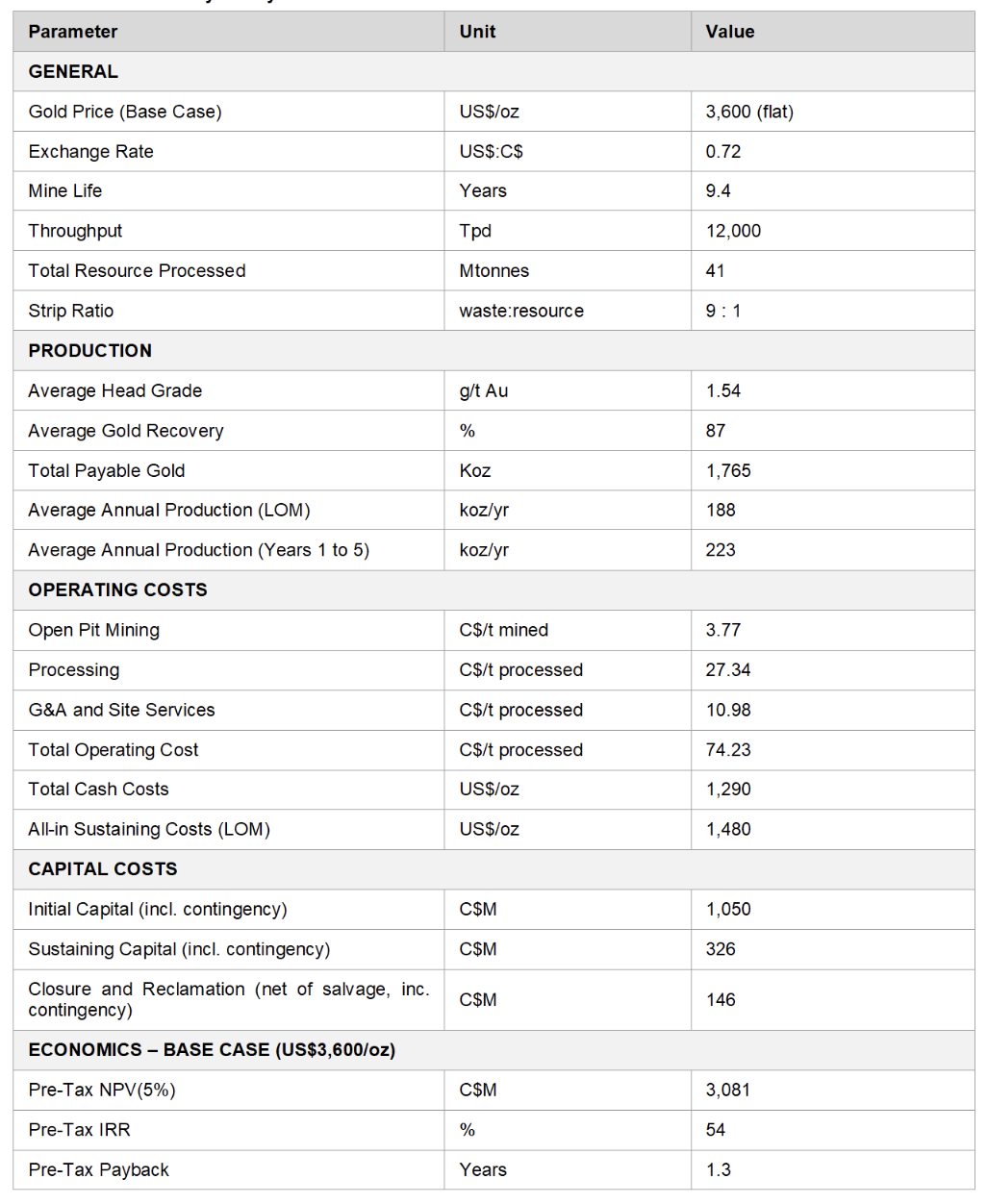
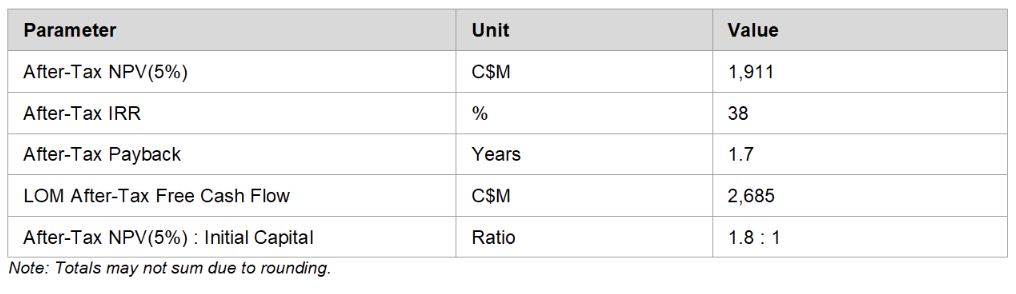
  • Positive Base Case Economics: After-tax net present value at five percent discount rate (NPV(5%)) of $1,911 million and after-tax internal rate of return (IRR) of 38% with a payback period of 1.7 years, at US$3,600/oz gold. Pre-tax NPV(5%) of $3,081 million and pre-tax IRR of 54%.
    
  • Strong Cash Generation: Life of mine after-tax free cash flow of $2,685 million, averaging approximately $280 million per year.
    
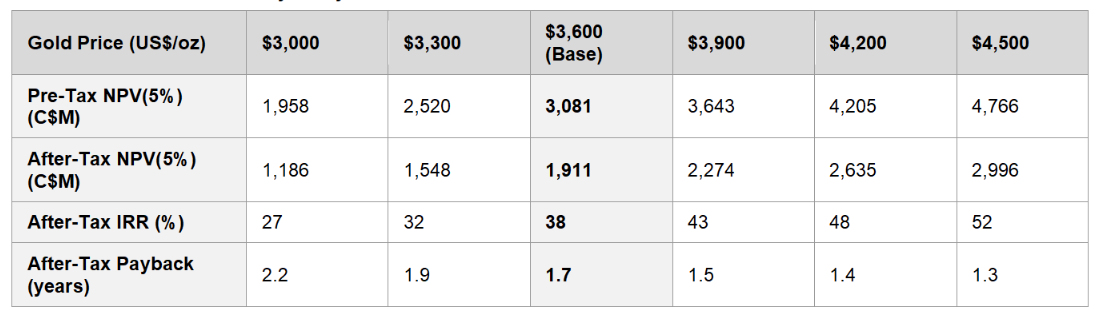
  • Significant Leverage to Gold Price: At US$4,500/oz, after-tax NPV(5%) increases to $2,996 million with an IRR of 52% (See Table 2).
    
  • Meaningful Production Scale: Average annual gold production of 188,000 ounces over a nine year mine life, averaging 223,000 ounces per year over the first five years, from a conventional open pit operation and 12,000 tonne per day mill.
    
  • Efficient cost structure: Life of mine cash costs of US$1,290/oz and all-in sustaining costs of US$1,480/oz.
    
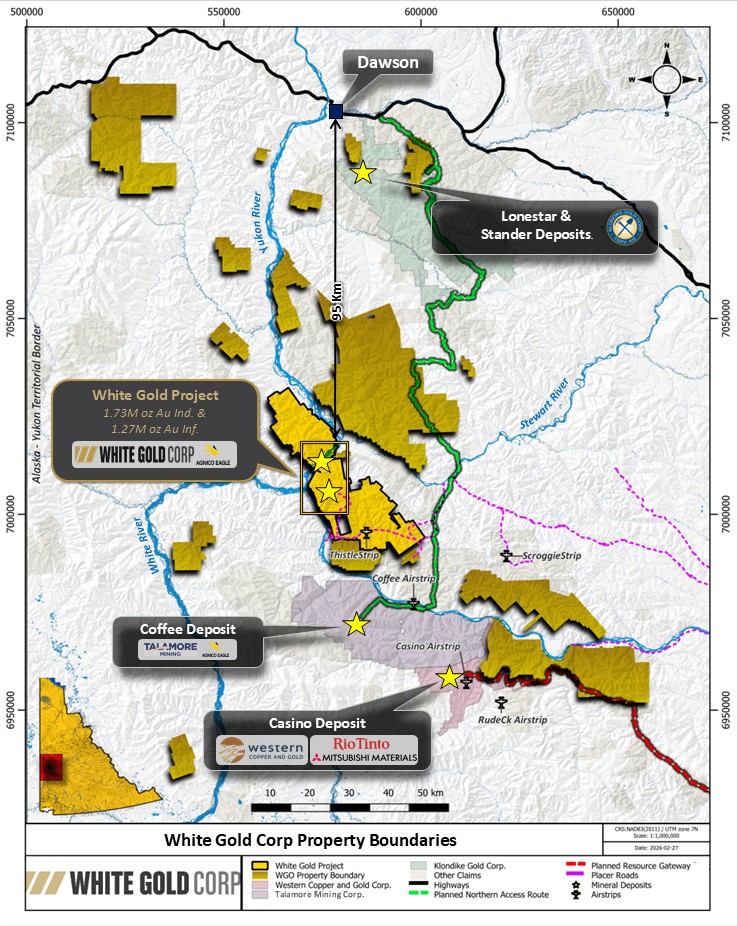
  • Established Road-Accessible Project: The White Gold Project is located in a region with a long history of placer mining, approximately 95 km south from Dawson City. The Project proposes to tie into the planned Northern Access Route (NAR) from Dawson City to neighbouring properties. The award of the construction contract (by others) for the NAR was announced earlier this year with mobilization underway. The Project will be accessed by an all-weather gravel road, which crosses the Stewart River by barge in summer and ice road in winter.
    
  • Favourable Jurisdiction: The Project is located within the Traditional Territory of the Tr'ondëk Hwëch'in in Canada's Yukon Territory, a stable mining jurisdiction with a well-defined regulatory process, government support for responsible resource development, and consistently strong rankings in global mining investment surveys.
    
  • First Phase of a District-Scale Opportunity: The PEA mine plan incorporates four deposits (Golden Saddle, Arc, Ryan's Surprise and VG) and only draws on approximately 60% of the Company's current mineral resource estimate completed in August 19th, 2025 of 1,732,300 ounces Indicated (35.2 Mt at 1.53g/t gold) and 1,265,900 ounces Inferred (32.3 Mt at 1.22 g/t gold). Drill results from 2025 and current drilling are not included in the resource, and all four deposits are still open for expansion. The Project covers approximately 55,000 hectares with more than 25 additional targets identified across the property, the majority of which have seen limited or no drilling.
    
  • Webinar Today: Company management will be hosting a live webinar TODAY August 10, 2026 at 12:00 PM EST to provide an overview of results. Interested parties are encouraged to register and attend here: https://6ix.com/event/white-gold-corp-announces-pea-results

"Our Maiden PEA is a significant milestone for White Gold, delivering a project with strong economics and significant growth potential. Few gold projects anywhere offer this combination of scale, potential returns, favourable jurisdiction and upside. I would like to thank and congratulate our team and all stakeholders who have supported us over the years in advancing The White Gold Project from a conceptual exploration idea towards a development asset with a PEA that compares very well to its peers in the sector. Even more exciting is the growth potential of the White Gold Project based on previous and ongoing drilling not included in the PEA, future drilling and the substantial potential of our underexplored truly district scale land package within the White Gold District, which has seen significant recent investment by prominent mine builders further advancing it towards becoming a leading Canadian mining camp. We are very fortunate to have the right projects, in the right place, at the right time, with a great team and supporters to continue to responsibly build value for all stakeholders," stated David D'Onofrio, Chief Executive Officer, White Gold Corp.

"This is a strong technical foundation, built on deliberately conservative assumptions. The PEA open pit mine plan draws on less than two thirds of our current resource ounces and applies preliminary recovery assumptions. A 9.4 year operation producing an average of 188,000 ounces annually is a compelling initial configuration for a district where mineralization remains open and most of our targets remain undrilled. Underground mining was not included in this maiden PEA but remains a separate opportunity that will be examined as deeper drilling advances the higher-grade resource at Golden Saddle. The PEA results demonstrate a potentially economic project on a resource estimate dated August 19, 2025, which includes drilling information up to November 1st, 2025. Additional gold ounces would add to the already very positive potential economics of the project. The work ahead of us, including expansion drilling on known zones, greenfield target drilling, metallurgical optimization, updated resource estimation and the next stage of economic study, is precisely the kind of work that increases value per share over time," stated Donovan Pollitt, P.Eng., CFA, President, White Gold Corp.

The PEA was prepared in accordance with the disclosure standards of National Instrument 43-101 ("NI 43-101"). The reader is cautioned that the PEA is preliminary in nature and includes Inferred Mineral Resources that are considered too speculative geologically to have the economic considerations applied to them that would enable them to be categorized as Mineral Reserves. There is no certainty that the PEA will be realized. Mineral resources that are not mineral reserves do not have demonstrated economic viability.


Figure 1: White Gold Project location and Quartz Claims Map

PEA Summary


The PEA was prepared by JDS Energy & Mining Inc. ("JDS") with contributions from Arseneau Consulting Services Inc. (“Arseneau”) and Knight Piésold Ltd. (“KP”), in accordance with NI 43-101.


Table 1: PEA Summary of Key Parameters and Economics

Gold Price Sensitivity


Potential project economics across a range of gold prices are presented in Table 2. The base case of US$3,600/oz is consistent with long-term consensus pricing.


Table 2: Gold Price Sensitivity Analysis (1)

(1) The disclosure of the results of the PEA presented in this news release contain certain prospective non‐GAAP financial measures or ratios such as cash operating cost, all in sustaining costs and sustaining costs. Such measures have no standardized meaning under International Financial Reporting Standards (“IFRS”) and may not be comparable to similar measures used by other issuers. The Company believes that these measures and ratios provide investors with an improved ability to evaluate the prospects of the Company. As the White Gold Project is not in production the prospective non‐GAAP financial measures or ratios may not be reconciliated to the nearest comparable measures under IFRS and the equivalent historical non-GAAP financial measure for each prospective non‐GAAP measure or ratio discussed herein is nil$.

Mineral Resource Estimate


The PEA is based on the Company's mineral resource estimate with an effective date of August 19, 2025, summarized in Table 3. The PEA mine plan incorporates the Golden Saddle, Arc, Ryan's Surprise and VG deposits. Approximately one third of current resource ounces, including the QV deposit, sit outside the PEA mine plan and represent potential future additions subject to further drilling and study.


Table 3: White Gold Project Mineral Resource Estimate (Effective August 19, 2025)

(2) Open pit resources reported at a 0.3 g/t Au cut-off and underground resources at a 2.3 g/t Au cut-off, at a gold price of US$2,250/oz. Approximately 99% of resources are near surface and amenable to open pit mining. The Golden Saddle deposit contains a high-grade core of over 1.1 million ounces Indicated at 2.84 g/t Au at a 1.0 g/t cut-off. Mineral resources are not mineral reserves and do not have demonstrated economic viability. All numbers are rounded; overall numbers may not be exact due to rounding. See the Company's technical report, August 19, 2025, for full parameters.

Mining


The PEA contemplates conventional open pit mining using truck and shovel methods at a nominal processing rate of 12,000 tonnes per day, with a total of 41 million tonnes of resource mined at an average grade of 1.54 g/t gold and a life of mine strip ratio of approximately 9:1, with 38% of material being classified as Inferred. The mine plan prioritizes higher-grade material in the early years of the production schedule after a one-year pre-strip period. Waste rock will be managed under a segregation protocol that separates potentially acid generating (PAG) material from non-acid generating (NAG) material, with PAG material placed in engineered, dedicated surface storage. This management approach is designed and costed in the PEA capital estimate rather than deferred to later study stages.


Processing and Recovery


In October 2025, White Gold initiated a metallurgical program to support the Preliminary Economic Assessment ("PEA"). Three representative mineralized domains were evaluated, designated VG, ARC, and Ryan’s Surprise, by Base Met labs to develop the flowsheet, characterize processing performance and provide key design parameters for the proposed processing facility. The test program assessed comminution characteristics, cyanide leach performance, cyanide detoxification, thickening, and filtration testing.


Ball mill work index testing was completed on samples from all three mineralized zones. The results demonstrated that the ARC and Ryan’s Surprise zones are of an average hardness while the VG sample can be classified as moderately hard.


Metallurgical optimization demonstrated that the implementation of a conventional carbon-in-leach ("CIL") processing flowsheet was the best option for the project. Testing confirmed that the Golden Saddle and VG deposits have similar metallurgy response with an average leach recovery of 92%. Predicted recoveries on material from the ARC and Ryan’s Surprise deposits, which comprise 30% of the material in the PEA production schedule, are 72%. The CIL flowsheet was determined to be the most applicable for the project because testwork indicates that carbon associated with the ARC and Ryan’s Surprise zones results in some preg-robbing. Preg-robbing is not an issue in the Golden Saddle and VG zones which comprise the bulk of the current mineral resource. The projected recovery for the four mineralized zones can be found in Table 3.


Table 3: Proposed CIL Recovery

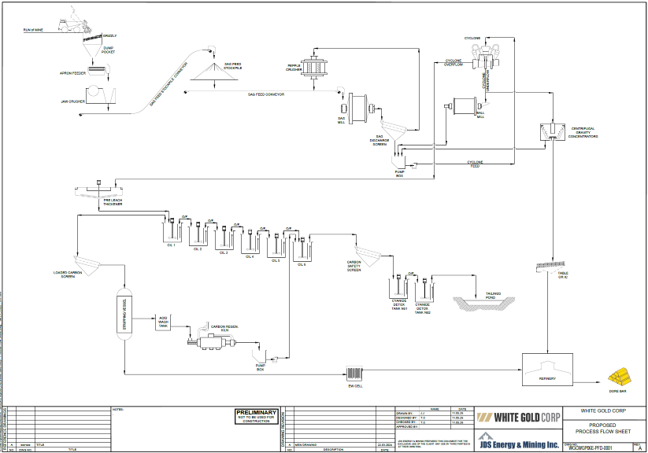
In addition to recovery optimization, supporting testwork was completed to advance process plant design. This included cyanide detoxification testing, tailings thickening, and filtration testwork to establish design criteria for the tailings management and water recovery circuits. The results provide the engineering parameters required for preliminary sizing of the detoxification, thickening, and filtration equipment incorporated into the PEA process plant design outlined in Figure 2.


Figure 2: Proposed Process Flowsheet

Project Infrastructure


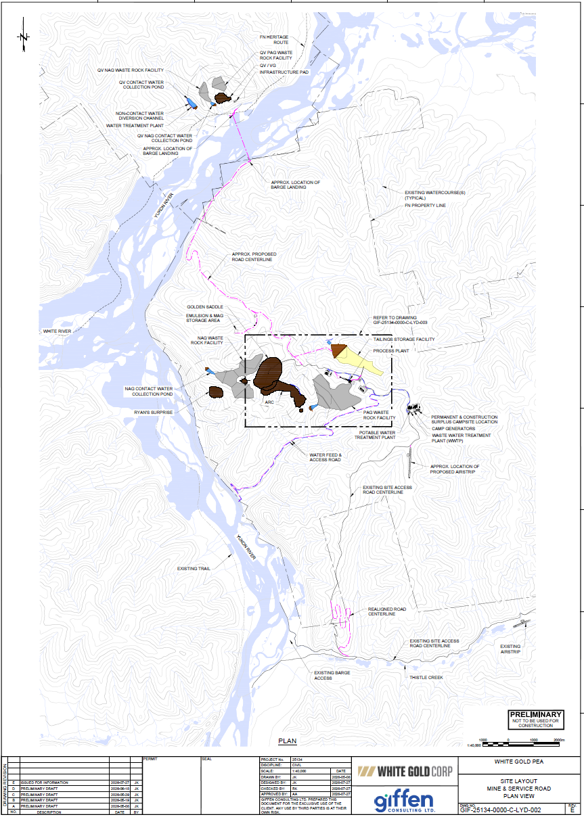
Project Infrastructure includes, an engineered tailings storage facility constructed in stages across the mine life, an on-site power plant and bulk fuel storage, water management and treatment facilities, an airstrip, and an accommodation camp. The tailings facility design incorporates staged embankment construction and basin lining, with most of the tailings capital deployed as sustaining capital in step with the production schedule. The Project proposes to tie into the planned Northern Access Route (NAR) from Dawson City to neighbouring properties. The award of the construction contract (by others) for the NAR was announced earlier this year with mobilization underway.


The overall layout showing the proposed location of the White Gold open pits, process plant, tailings and waste storage facilities, and project infrastructure is provided below in Figure 3.


Figure 3: White Gold Proposed Site Layout

Capital Costs


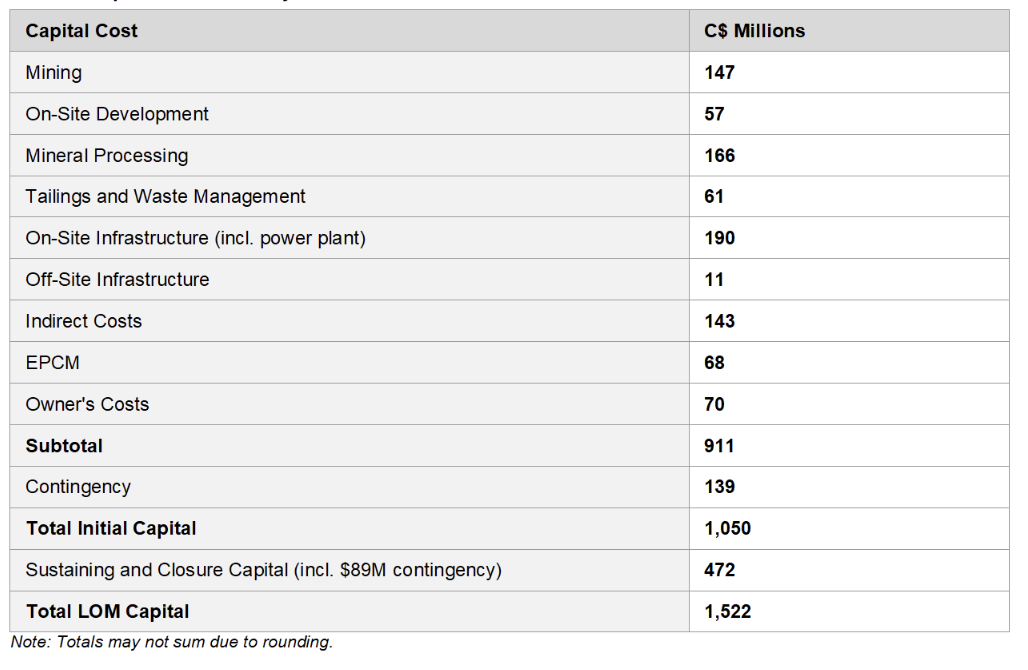
Initial capital is estimated at $1,050 million, inclusive of $139 million of contingency. Contingency was estimated by working area, with the highest rates applied to the process plant and tailings storage facility. Sustaining and closure capital of $472 million over the life of mine is driven primarily by staged tailings construction and includes closure and reclamation costs of $146 million net of salvage value, including contingency.


Table 4: Capital Cost Summary

Operating Costs


Life of mine operating costs are estimated at $74.23 per tonne processed, comprising open pit mining of $3.77 per tonne mined, processing of $27.34 per tonne processed, and G&A and site services of $10.98 per tonne processed. Life of mine cash costs are US$1,290 per ounce and all-in sustaining costs are US$1,485 per ounce. Average annual operating costs are estimated to be $350 million annually.


Project Opportunities


The PEA is based on the current resource dated August 19, 2025, which includes drilling information up to November 1st, 2025. A total of 2,500 metres of drilling have been completed since then in 2025 with 15,000 to 20,000 metres being drilled on the project in 2026. The Company has identified a number of opportunities with the potential to extend mine life, increase annual production, and improve project economics in subsequent studies:


  • Resource conversion and growth at existing deposits. Approximately one third of current resource ounces sit outside the PEA mine plan. Mineralization at the deposits included in the PEA mine plan remains open along strike and at depth, and these areas are logical candidates for incorporation in future studies as drilling advances.
    
  • Underground mining potential at Golden Saddle. Underground mining was not part of the PEA. Current drilling is targeted on this higher-grade portion of the deposit. The potential for underground mining will be examined as deeper drilling advances.
    
  • Metallurgical optimization for Arc and Ryan's Surprise. The PEA applies a preliminary recovery of 72.5% to Arc and Ryan's Surprise material. Further test work targeting improved recoveries from these deposits is a direct lever on project economics.
    
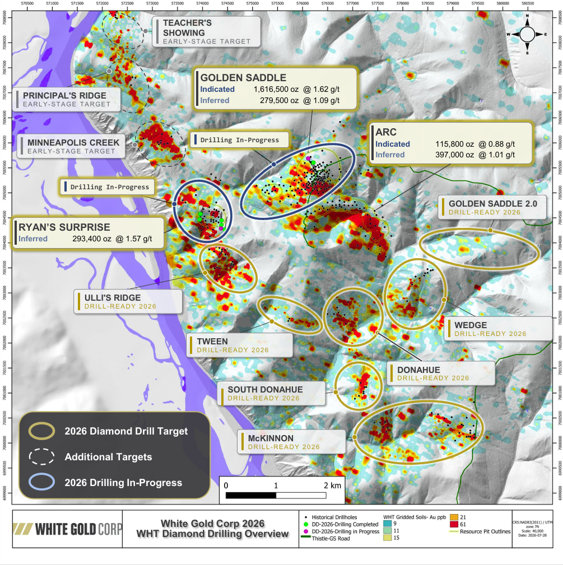
  • District exploration pipeline. The property hosts more than 25 identified targets developed through the Company's systematic, data-driven exploration methodology. The majority have seen limited or no drill testing.
    
  • Mine life extension through satellite feed. The processing facility is designed with capacity to accept feed from satellite deposits within trucking distance, providing a pathway to extend operations beyond the current mine plan without proportional capital addition.


Figure 4: Known deposits and property target pipeline

First Nations and Community


The White Gold Project lies within the Traditional Territory of the Tr'ondëk Hwëch'in. The Company understands the importance of the land and water to First Nations and is committed to building on its longstanding relationship with the Tr'ondëk Hwëch'in. The Company also acknowledges and commits to building relationships with the First Nations of White River, Selkirk and Na-Cho Nyäk Dun whose Traditional Territories overlap or partially overlap with a portion of the Company’s mineral tenures or the proposed access route to the Project. The Company will engage openly and consistently as the Project advances through assessment, permitting, and development. Ensuring the Project delivers lasting benefits to the communities in the region, and the entire Yukon, will be a fundamental consideration as the Project moves forward.


Permitting and Environmental


A foundation of historical site environmental work exists, supported by substantial regional baseline information. As the Project advances beyond the PEA stage, the Company expects to complete additional environmental baseline studies to support project design, First Nation engagement and consultation processes, and future permitting requirements.


Mine development would be subject to environmental and socio-economic assessment under the Yukon Environmental and Socio-economic Assessment Act (“YESAA”), administered by the Yukon Environmental and Socio-economic Assessment Board (“YESAB”), followed by the issuance of key authorizations by the Yukon Government, including Quartz Mining and Water Use Licenses. The scope of studies typically required to support First Nation consultation and Yukon regulatory review is well established in Yukon with recent permitting precedents. At this time, the Company is not aware of any site-specific environmental issues that would be expected to materially adversely affect its ability to develop the Project as contemplated in the PEA.


Next Steps


With the PEA complete, the Company's near-term priorities include:


  • 15,000-20,000 metres of drilling currently underway in 2026 focused on expanding known zones, with 3 drill rigs currently active on the property with a goal of continuing to increase total resources;
    
  • Test promising new zones identified by soil geochemistry and geophysics.
    
  • Additional metallurgical test work focused on Arc and Ryan's Surprise to further optimize recoveries and supporting the next study stage;
    
  • Initiate programs to geotechnically and geochemically characterize the tailings and waste rock;
    
  • Commence environmental baseline data collection and advancement of YESAA-readiness work; and
    
  • Ongoing engagement with the Tr'ondëk Hwëch'in and White River as well as neighbouring First Nations and the Yukon Government.


Qualified Persons


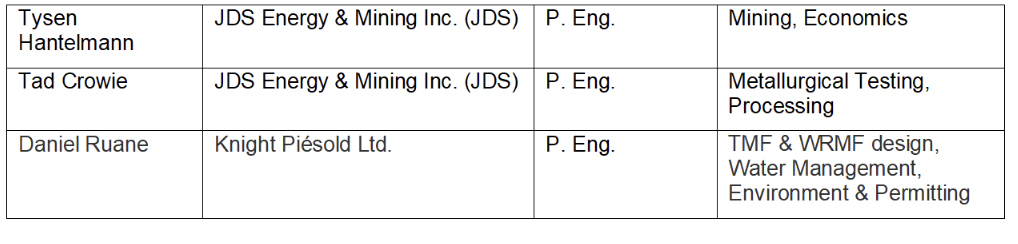
The scientific and technical information included in this news release were reviewed and approved by the Qualified Persons listed in Table 5.


Table 5: Qualified Persons

About White Gold Corp.


The Company owns a portfolio of 15,364 quartz claims across 21 properties covering 305,102 hectares (3,051 km2) representing approximately 40% of the Yukon's emerging White Gold District. The Company's flagship White Gold Project hosts four near-surface gold deposits which collectively contain a resource estimate of 1,732,300 ounces of gold in indicated resources (35.2 million tonnes grading 1.53 grams per tonne gold) and 1,265,900 ounces of gold in inferred resources (32.2 million tonnes grading 1.22 g/t Au) (see the Company's news release dated October 6, 2025)(1)(2). Regional exploration work has also produced several other new discoveries and prospective targets on the Company's claim packages which border sizable gold discoveries including the Coffee Project owned by Talamore Mining (formerly Fuerte Metals) and Western Copper and Gold Corporation's Casino Project. The Company is strategically supported by major shareholders Agnico Eagle Mines Limited. For more information visit www.whitegoldcorp.ca.


(3) White Gold Corp. “White Gold Corp. Files Technical Report Demonstrating Significant 44% Increase in Indicated Resources to 1,732,300 oz Gold (35.2 million tonnes grading 1.53 g/t) and 13.4% Increase in Inferred Resources to 1,265,900 oz Gold (32.2 million tonnes grading 1.22 g/t) at its Flagship White Gold Project, Yukon, Canada” Press Release 6 Oct, 2025. https://www.whitegoldcorp.ca/news/white-gold-corp-files-technical-report-demonstrating-significant-44-increase-in-indicated-resources-to-1732300-oz-gold-352-million-tonnes-grading-153-gt-and-134-increase-in-inferred-resources-to-1265900-oz-gold-322-million-ton

(4) All numbers are rounded. Overall numbers may not be exact due to rounding.


Technical Report


Additional supporting details regarding the information in this news release will be included in a Technical Report prepared in accordance with NI 43-101 and filed on SEDAR+ under the Company’s issuer profile at www.sedarplus.ca within 45 days of the date of this news release. It will include further details on qualifications, assumptions, exclusions and risks that relate to the details of this news release, including the PEA and Mineral Resource estimate. The Technical Report is intended to be read as a whole, and sections should not be read or relied upon out of context.


Cautionary Statement Regarding the PEA


The reader is advised that the PEA summarized in this news release is only a conceptual study of the potential viability of the White Gold Project, and the economic and technical viability of the White Gold Project and its estimated Mineral Resources has not been demonstrated. The PEA is preliminary in nature and provides only an initial, high-level review of the White Gold Project’s potential and design options; there is no certainty that the PEA will be realized. The PEA conceptual mine plan and economic model include numerous assumptions and Mineral Resource estimates including Inferred Mineral Resource estimates. Inferred Mineral Resource estimates are considered to be too speculative geologically to have any economic considerations applied to such estimates. There is no guarantee that Inferred Mineral Resource estimates will be converted to Indicated or Measured Mineral Resources, or that Indicated or Measured Mineral Resources can be converted to Mineral Reserves. Mineral Resources that are not Mineral Reserves do not have demonstrated economic viability, and as such there is no guarantee the White Gold Project economics described herein will be achieved. Mineral Resource estimates may be materially affected by environmental, permitting, legal, title, taxation, socio-political, marketing, or other relevant risks, uncertainties and other factors, as more particularly described herein and to be described in the Technical Report.


In accordance with applicable Canadian securities laws, all Mineral Resource estimates disclosed or referenced in this news release have been prepared in accordance with the disclosure standards of and have been classified in accordance with CIM’s “Definition Standards for Mineral Resources and Reserves”. Under Canadian securities rules, estimates of Inferred Mineral Resources may not form the basis of an economic analysis, except for a preliminary economic assessment as defined under NI 43-101. Investors are cautioned not to assume that part or all of an Inferred Mineral Resource exists or is economically or legally mineable.


Cautionary Note Regarding Forward Looking Information


This news release contains "forward-looking information" within the meaning of applicable Canadian securities legislation, including statements with respect to the future or estimated financial and operational performance of the White Gold Project under the PEA; the estimation of Mineral Resources and the realization of such mineral estimates; expectations with respect to updating the Inferred Mineral Resources to Indicated Mineral Resources with further drilling; the statements related to the PEA and other results of the PEA discussed in this news release, including, without limitation, project economics, financial and operational parameter such as expected production, cash costs, all-in sustaining costs, other costs, capital expenditures, cash flow, NPV, IRR, payback period and life of mine; planned drilling and exploration program and the timing and success of such activities, planned metallurgical test work; upside potential, opportunities for growth and expected next steps; potential gold and other metal recoveries; and the price of gold, and other commodities.


Forward-looking statements are inherently uncertain, and the actual performance may be affected by a number of material factors, assumptions and expectations, many of which are beyond the control of the Company, including expectations and assumptions concerning general economic and industry conditions, applicable laws and regulations, commodity prices, the use of proceeds, and the future business and operational needs of the Company. Readers are cautioned that assumptions used in the preparation of any forward-looking statements may prove to be incorrect. Events or circumstances may cause actual results to differ materially from those predicted as a result of numerous known and unknown risks, uncertainties, and other factors, many of which are beyond the control of the Company. In addition to factors already discussed in this news release, such factors include, among others, risks relating to the Company’s business, including possible variations in grade and recovery rates; uncertainties inherent to the conclusions of economic evaluations and economic studies; changes in project parameters, including schedule and budget, as plans continue to be refined; uncertainties with respect to actual results of current exploration activities; uncertainties inherent to the estimation of Mineral Resources, which may not be fully realized; uncertainties inherent with conducting business in foreign jurisdictions and uncertainties with the rule of law may impact the Company’s activities; the impact of the conflicts in the Ukraine and the Middle-East and health emergencies, including resulting changes to the Company’s supply chain and costs of supplies; product shortages; delivery and shipping issues; closures and/or failure of plant, equipment or processes to operate as anticipated; employees and contractors become infected with pathogens or being affected by the war; lost work hours; labour force shortages; fluctuations in metal and acid prices, toll rates and foreign exchange rates; limitation on insurance coverage; accidents, labour disputes and other risks of the mining industry; delays in obtaining governmental approvals or financing or in the completion of development or construction activities; opposition by social and non-government organizations to mining projects; unanticipated title disputes; claims or litigation; cyber attacks and other cybersecurity risks; as well as those risk factors discussed or referred to in any other documents filed from time to time with the securities regulatory authorities in the provinces and territories of Canada and available on SEDAR+ at www.sedarplus.ca. The reader has been cautioned that the foregoing list is not exhaustive of all factors which may have been used. Although the Company has attempted to identify important factors that could cause actual actions, events or results to differ materially from those described in forward-looking statements, there may be other factors that cause actions, events or results not to be anticipated, estimated or intended.


Readers are further cautioned not to place undue reliance on any forward-looking statements, as such information, although considered reasonable by the respective management of the Company at the time of preparation, may prove to be incorrect and actual results may differ materially from those anticipated.


Neither the TSXV nor its Regulation Services Provider (as that term is defined in the policies of the TSXV) accepts responsibility for the adequacy or accuracy of this news release.


For Further Information, Please Contact:


David D'Onofrio

Chief Executive Officer

White Gold Corp.

(647) 930-1880

ir@whitegoldcorp.ca


Request Meeting: https://calendly.com/meet-with-wgo/15min

FOLLOW US
Twitter  Facebook  Linkedin  Instagram  Youtube  

Minggu, 02 Agustus 2026

6 Best Iron Filters for Well Water in 2026

Iron in well water can leave orange stains on toilets, discolor laundry, create a metallic taste, and gradually build up inside plumbing fixtures and appliances. A properly selected iron filter treats the water before it reaches the rest of the house.

The best iron filter for well water depends on more than the brand name. You need to consider the amount and type of iron in the water, the presence of manganese or hydrogen sulfide, household water demand, pH, hardness, maintenance requirements, and available installation space.

The U.S. Environmental Protection Agency lists 0.3 milligrams per liter, or parts per million, as the secondary standard for iron in drinking water. Iron above this level may cause rusty color, sediment, metallic taste, and reddish-orange staining. 

After comparing treatment method, flow rate, iron-removal capability, maintenance, installation requirements, and suitability for different well-water conditions, these are the six best iron filters for well water.

Best Iron Filter for Well Water: Quick Comparison
Rank
Iron filter
Best for
Treatment type
Notable feature
1
SpringWell WS Series
Best overall
Air-injection oxidation and backwashing filtration
Treats iron, manganese, and sulfur
2
Culligan Smart High Efficiency Iron-Cleer
Best professionally installed system
Oxidation and automatic filtration
Smart monitoring and dealer support
3
Waterdrop WD-WHF3T-FG
Best cartridge-based value
Seven-stage cartridge filtration
15 GPM flow rate
4
SpringWell Filter and Salt-Based Softener
Best for iron and hard water
Oxidation filtration and ion-exchange softening
Treats multiple well-water problems
5
Fleck 2510-Based Iron Filter
Best customizable system
Configurable backwashing filtration
Flexible media and treatment setup
6
iSpring WHO32B-MKS
Best freestanding cartridge system
Three-stage cartridge filtration
Drain-assisted filter changes 1. SpringWell WS Series — Best Overall Iron Filter for Well Water

The SpringWell WS Series ranks first because it combines strong iron-removal capability with a chemical-free air-injection oxidation process.

The system creates an air pocket inside the treatment tank. As well water passes through this area, dissolved iron, manganese, and hydrogen sulfide are oxidized into particles that can be captured by the filter media. The system then backwashes automatically to flush accumulated contaminants into a drain.

SpringWell states that its air-injection system can treat up to 7 parts per million of iron, 1 part per million of manganese, and 8 parts per million of hydrogen sulfide. 

Two sizes are available:

  • The WS1 provides a service flow rate of 12 gallons per minute.
  • The WS4 provides a service flow rate of 18 gallons per minute.

The WS1 is generally suited to smaller and medium-sized households, while the WS4 provides additional capacity for larger homes with four or more bathrooms. Both systems require a drain connection and sufficient well-pump capacity for backwashing. 

Why it ranks first

The SpringWell WS Series is designed specifically for the most common aesthetic problems associated with well water: iron stains, black manganese deposits, and rotten-egg odor caused by hydrogen sulfide.

Unlike cartridge filters, the primary media does not require replacement every few months. Automatic backwashing reduces routine maintenance, although the control head, drain line, and media bed still need periodic inspection.

Advantages
  • Treats iron, manganese, and hydrogen sulfide
  • No routine chemical injection
  • Automatic backwashing
  • Available in 12 GPM and 18 GPM configurations
  • Suitable for whole-house treatment
  • Strong documented iron-treatment capacity
Limitations
  • Requires electricity and a drain
  • Needs adequate well-pump flow for backwashing
  • May require professional installation
  • Does not soften hard water
Best for

Homes with moderate to high iron levels, sulfur odor, manganese staining, or several related well-water problems.

2. Culligan Smart High Efficiency Iron-Cleer — Best Professionally Installed Iron Filter

The Culligan Smart High Efficiency Iron-Cleer is a strong option for homeowners who prefer professional water testing, system sizing, installation, and ongoing service.

The system uses an oxidation process to convert dissolved iron into filterable particles. It is intended to address metallic taste, rust-colored stains, manganese, and hydrogen sulfide odor. Its smart controls provide continuous system monitoring and allow users to review operating information remotely. 

Culligan also offers the Select Plus Series Iron-Cleer as a less technology-focused alternative. This system is designed for both well and municipal water and targets staining, unpleasant taste, appliance buildup, and hydrogen sulfide odor. 

Why it ranks second

Water chemistry can make iron treatment complicated. Factors such as pH, iron type, manganese, sulfur, tannins, and bacterial activity may affect performance. Culligan’s dealer-based model is useful when a homeowner does not want to size, install, program, and troubleshoot the equipment independently.

The main disadvantage is that product specifications and costs may depend on the system configuration recommended by the local dealer.

Advantages
  • Professional water testing and sizing
  • Automatic oxidation and filtration
  • Smart system monitoring
  • Treats iron-related staining and metallic taste
  • Can address manganese and hydrogen sulfide
  • Installation and service support are available
Limitations
  • Usually requires a dealer consultation
  • Pricing is not as transparent as direct-purchase systems
  • Features and capacity may vary by configuration
  • Homeowners have less control over installation
Best for

Homeowners who want a professionally configured iron filter with monitoring, installation, and local service.

3. Waterdrop WD-WHF3T-FG — Best Cartridge-Based Value

The Waterdrop WD-WHF3T-FG is a three-housing whole-house filter that uses seven stages of filtration to reduce iron, manganese, chlorine, rust, sediment, sand, and odor.

According to Waterdrop, third-party initial-performance testing showed reductions of 95.9% for iron, 99.7% for manganese, and 97.7% for chlorine. The system also carries NSF/ANSI 372 certification for lead-free materials. 

The WD-WHF3T-FG provides a rated flow of 15 gallons per minute and uses 5-micron filtration. Its iron-and-manganese cartridges are listed for approximately six to twelve months of service, although actual filter life depends heavily on contaminant levels and household water consumption. 

Why it ranks third

This Waterdrop system is easier to understand and maintain than a large backwashing tank. It does not require an electronic control valve or automatic regeneration cycle.

Its compact design and 15 GPM flow rate make it practical for homes with limited utility-room space. It also treats sediment and chlorine-related issues alongside iron and manganese.

However, percentage-reduction results should not be confused with a maximum supported iron concentration. Homeowners with severe iron contamination should confirm that a cartridge system can handle their laboratory results before purchasing.

Advantages
  • Seven-stage filtration
  • 15 GPM whole-house flow rate
  • Reduces iron, manganese, sediment, rust, chlorine, and odor
  • Compact compared with tank-based filters
  • No automatic backwashing cycle
  • Lead-free material certification
Limitations
  • Replacement cartridges create recurring expenses
  • Severe iron may clog cartridges quickly
  • No published maximum influent iron level on the product page
  • Does not remove hardness
  • Filter life varies substantially with water quality
Best for

Homes with mild to moderate iron, manganese, sediment, or chlorine concerns that need an accessible cartridge-based whole-house filter.

4. SpringWell Well Water Filter and Salt-Based Softener — Best for Iron and Hard Water

Iron and hardness are separate water-quality problems. An iron filter oxidizes and captures iron, while a water softener uses ion exchange to reduce calcium and magnesium.

The SpringWell Well Water Filter and Salt-Based Softener combines an air-injection iron filter with a conventional salt-based softener. This configuration treats iron, manganese, and hydrogen sulfide before reducing hardness minerals.

The iron-filter portion is rated for up to 7 parts per million of iron, 1 part per million of manganese, and 8 parts per million of hydrogen sulfide. The WS1 iron filter provides a 12 GPM service flow, while the WS4 provides an 18 GPM service flow. The corresponding softeners are available in different capacities for smaller and larger households. 

Why it ranks fourth

This combination is more appropriate than using a water softener alone when the well contains substantial iron. Heavy iron loading can foul a softener’s resin and reduce its efficiency. Placing a dedicated iron filter before the softener protects the softening stage and treats a broader range of water problems.

The tradeoff is increased equipment size, installation complexity, salt use, wastewater discharge, and maintenance.

Advantages
  • Treats iron and hard water in one coordinated setup
  • Reduces manganese and hydrogen sulfide
  • Helps protect the softener from heavy iron loading
  • Available for different household sizes
  • Automatic iron-filter backwashing
  • Provides softened water throughout the house
Limitations
  • Requires more installation space
  • Needs electricity, drainage, and a brine tank
  • Requires regular salt replenishment
  • Produces backwash and regeneration wastewater
  • More complex than a single iron filter
Best for

Well-water homes experiencing orange iron stains, scale buildup, soap scum, spotted dishes, and other signs of both iron and hardness.

5. Fleck 2510-Based Iron Filter — Best Customizable Iron-Removal System

A Fleck 2510-based iron filter is not always sold as one standardized package. Instead, the Fleck control valve may be paired with different tank sizes, oxidation methods, injectors, and filter media.

This flexibility allows a water-treatment professional to configure the system for the household’s iron level, pH, manganese concentration, sulfur odor, flow requirements, and available backwash rate.

The Fleck 2510 is used on automatic backwashing and regeneration systems. Its installation requirements include a drain, a bypass arrangement, appropriate water pressure, and sufficient backwash flow. Fleck documentation also warns that plumbing heavily clogged with iron should be cleaned or replaced and that a dedicated iron filter may be required ahead of a softener. 

Why it ranks fifth

A properly configured Fleck system can provide effective treatment and long-term serviceability. Replacement valves, seals, injectors, pistons, and control components are commonly serviceable rather than requiring replacement of the complete tank assembly.

Its main weakness is inconsistency between sellers. Two systems labeled as Fleck 2510 iron filters may use different media, tank sizes, oxidation methods, and programming. Buyers must examine the complete treatment package rather than evaluating the valve name alone.

Advantages
  • Highly configurable
  • Automatic backwashing
  • Serviceable control platform
  • Can be paired with different iron-filter media
  • Suitable for professionally designed systems
  • Available in different tank and flow configurations
Limitations
  • Performance depends on the complete system configuration
  • No single universal iron-removal rating
  • Requires correct programming and backwash flow
  • Usually needs professional sizing
  • Product quality may vary between assembled packages
Best for

Homeowners working with a knowledgeable installer who can build and program a system around detailed laboratory water-test results.

6. iSpring WHO32B-MKS — Best Freestanding Cartridge Iron Filter

The iSpring WHO32B-MKS is a three-stage whole-house cartridge system designed for iron, manganese, hydrogen sulfide, sediment, chlorine, and certain heavy metals.

The system is rated to treat dissolved iron concentrations of up to 3 parts per million and manganese concentrations of up to 1 part per million. It provides a flow rate of up to 15 gallons per minute. iSpring states that the cartridges may last for up to 150,000 gallons or 12 months, whichever occurs first. Actual service life will depend on the water’s contaminant concentration and household usage. 

The horizontal housings include drain valves that allow users to release pressure and drain water before removing the cartridges. The system also stands on its own steel frame, eliminating the need to mount heavy filter housings on a wall.

Why it ranks sixth

The WHO32B-MKS offers clearly stated iron and manganese limits, high whole-house flow, standard-sized cartridges, and a more convenient filter-change design.

It ranks below the backwashing systems because cartridge consumption can become expensive when well water contains heavy iron or sediment. The product page also indicated that the model was out of stock when reviewed, so availability should be verified before purchase. 

Advantages
  • Treats up to 3 PPM of dissolved iron
  • Treats up to 1 PPM of manganese
  • Up to 15 GPM flow rate
  • Targets hydrogen sulfide odor
  • Freestanding steel frame
  • Drain valves simplify cartridge replacement
  • Uses standard 20-by-4.5-inch cartridges
Limitations
  • Cartridge life decreases in heavily contaminated water
  • Replacement filters create recurring costs
  • Not intended for iron levels above its stated limit
  • Does not soften hard water
  • Availability may vary
Best for

Homes with low to moderate dissolved iron that need a freestanding cartridge system with easier filter changes.

How to Choose the Best Iron Filter for Well Water Test the well water first

Do not select an iron filter based only on orange stains or metallic taste. Obtain laboratory results for:

  • Total iron
  • Ferrous and ferric iron, when available
  • Manganese
  • pH
  • Hardness
  • Hydrogen sulfide
  • Turbidity and sediment
  • Tannins
  • Coliform bacteria
  • Nitrate and other locally relevant contaminants

The CDC recommends testing private well water at least once each year for total coliform bacteria, nitrates, total dissolved solids, and pH. Additional testing should be based on local conditions and observed water-quality problems. 

Identify the type of iron

Ferrous iron is dissolved and may initially appear clear. After exposure to air, the water can turn orange or brown. Ferric iron is already oxidized and may make the water appear discolored immediately. Organic or colloidal iron can be more difficult to remove because it may remain suspended or be associated with natural organic matter. 

A basic sediment cartridge may capture ferric particles but usually will not remove substantial dissolved ferrous iron without an oxidation stage.

Match the filter to the iron concentration

For lower iron levels, a specialized cartridge system may be sufficient. Higher concentrations generally favor an oxidation and backwashing system with a clearly documented iron limit.

Never assume that a filter reporting a high percentage reduction can treat water with any iron concentration. Reduction percentage, test conditions, filter capacity, and maximum influent concentration are different measurements.

Check pH requirements

Oxidation and filter-media performance can be affected by pH. Some iron filters work poorly in acidic water. Compare the laboratory pH result with the manufacturer’s operating range and determine whether a neutralizer is needed.

Confirm the required flow rate

The service flow rate must support simultaneous fixtures without causing a major pressure drop. Larger households, multiple bathrooms, high-flow showers, and large appliances may require a higher-capacity model.

Backwashing tank systems also need sufficient well-pump output. A filter that requires 5 or 7 GPM for backwashing may not clean itself properly if the well pump cannot maintain that rate.

Consider manganese and sulfur

Black staining may indicate manganese, while a rotten-egg smell often points to hydrogen sulfide. Choose a system specifically rated for these problems rather than assuming that every iron filter will remove them.

Decide between cartridge and backwashing filters

Cartridge iron filters generally have a lower initial complexity and require less floor space. They are often suitable for mild or moderate contamination.

Backwashing filters cost more to install but are generally better suited to higher contaminant loads. Instead of replacing cartridges frequently, they clean the media automatically by reversing water flow and sending accumulated material to a drain.

Frequently Asked Questions What is the best iron filter for well water?

The SpringWell WS Series is the best overall option in this ranking because it has a clearly stated iron-treatment limit, automatic backwashing, multiple flow-rate options, and the ability to treat manganese and hydrogen sulfide.

The most appropriate system still depends on laboratory water-test results.

How much iron can an iron filter remove?

Capacity varies by design. In this comparison, the SpringWell air-injection system is rated for up to 7 PPM of iron, while the iSpring WHO32B-MKS is rated for up to 3 PPM.

Other systems may report percentage reductions rather than a maximum incoming iron concentration. These figures should not be treated as interchangeable.

Will an iron filter remove the rotten-egg smell from well water?

Only filters designed to treat hydrogen sulfide should be expected to reduce rotten-egg odor. The SpringWell WS Series, Culligan Iron-Cleer systems, and iSpring WHO32B-MKS are designed to address hydrogen sulfide alongside iron.

Can a water softener remove iron?

A softener may reduce small amounts of dissolved iron, but it is not a substitute for a dedicated iron filter when iron concentrations are substantial. Excess iron can foul the resin, increase salt consumption, and shorten service life.

For water containing both high iron and hardness, an iron filter followed by a softener is generally the more appropriate configuration.

Do iron filters remove bacteria?

An iron filter should not be assumed to disinfect well water. Iron bacteria and disease-causing microorganisms require separate evaluation and may need well cleaning, disinfection, or an additional treatment stage.

Have the water tested by a qualified laboratory before relying on any filtration system for microbiological safety.

How often should an iron filter be replaced?

Replacement frequency depends on the type of filter.

Cartridge filters may require replacement every few months or approximately once per year. Backwashing media systems can operate for several years, but valves, injectors, drainage components, and media still require inspection and eventual servicing.

Does an iron filter reduce water pressure?

Any filter can reduce pressure if it is undersized, clogged, incorrectly installed, or operated beyond its rated flow. Select a system with sufficient service flow for the household and replace or backwash the filter as required.

Final Verdict

The SpringWell WS Series is the best iron filter for well water overall because of its air-injection oxidation process, automatic backwashing, strong documented iron capacity, and ability to treat manganese and hydrogen sulfide.

The Culligan Smart High Efficiency Iron-Cleer is the strongest choice for homeowners who prefer professional testing, installation, monitoring, and service.

The Waterdrop WD-WHF3T-FG provides a practical cartridge-based option for mild to moderate iron and sediment. The SpringWell filter-and-softener combination is more suitable when the home has both iron contamination and hard water.

A Fleck 2510-based system offers extensive customization when designed by a qualified installer. The iSpring WHO32B-MKS is a useful freestanding cartridge system for iron concentrations within its stated 3 PPM limit.

Before purchasing any iron filter for well water, test the water, confirm the type and concentration of iron, verify the household flow requirement, and check whether the well pump can support the system’s backwashing needs.

--
You received this message because you are subscribed to the Google Groups "Broadcaster" group.
To unsubscribe from this group and stop receiving emails from it, send an email to broadcaster-news+unsubscribe@googlegroups.com.
To view this discussion visit https://groups.google.com/d/msgid/broadcaster-news/948625b6-dd7e-4d95-a38d-d1d0986b289bn%40googlegroups.com.